onnx2tf
A tool for converting ONNX files to LiteRT/TFLite/TensorFlow, PyTorch native code (nn.Module), TorchScript (.pt), state_dict (.pt), Exported Program (.pt2), and Dynamo ONNX. It also supports direct conversion from LiteRT to PyTorch.
You should use LiteRT Torch rather than onnx2tf. https://github.com/google-ai-edge/litert-torch and https://github.com/google-ai-edge/ai-edge-quantizer








tf_converter supported layers
flatbuffer_direct execution path
flatbuffer_direct is now the default backend. It is faster and has a higher success rate than tf_converter for the supported direct path. The simplest conversion command now outputs only a LiteRT model by default, but if you add --flatbuffer_direct_output_saved_model, it will also output a saved_model. Unlike the legacy tf_converter path, this SavedModel is built from the LiteRT-side ModelIR.
[!IMPORTANT]
flatbuffer_direct is the current default backend. Use --tflite_backend tf_converter only when you explicitly need the legacy TensorFlow Lite Converter compatibility path.

With the default flatbuffer_direct backend, onnx2tf uses a direct fast path for both ONNX input and -it/--input_tflite_file_path input:
- ONNX graph preprocessing (
tflite_builder.preprocess) and direct lowering (lower_onnx_to_ir)
- Direct FlatBuffer export (
*_float32.tflite, *_float16.tflite, and optional quantized variants)
- Optional direct reports/evaluation (
*_op_coverage_report.json, tensor correspondence, ONNX/TFLite check)
In this fast path, the per-node TensorFlow conversion (op.make_node() over all ONNX nodes) is skipped.
This removes the long debug traces such as:
INFO: <index> / <total>INFO: onnx_op_type: ...INFO: tf_op_type: ...
Measured example (same model, float32 TFLite write stage):
tf_converter: ~24.947sflatbuffer_direct: ~0.239sflatbuffer_direct was approximately 107x faster than tf_converter in this case.
Actual speedup depends on model structure, enabled options, and runtime environment.
Direct export can also generate TF-side artifacts without falling back to tf_converter:
--output_h5--output_keras_v3--output_tfv1_pb--flatbuffer_direct_output_pytorch
These artifacts are generated from an internal SavedModel bridge built from float32 ModelIR.
If direct export fails, conversion stops with an explicit error.
-inimc / -onimc also stay on the direct path in flatbuffer_direct.
For ONNX input and -it input, these options crop the imported/lowered ModelIR
at the specified boundary tensor names instead of splitting the ONNX graph.
-dgc, -ebu, and -eru also stay on the direct path in flatbuffer_direct.
For ONNX input they are applied during lowering or as post-lowering ModelIR rewrites.
For -it input they are applied to imported ModelIR before SavedModel bridge,
split planning, or rewritten TFLite export.
If the requested rewrite cannot be applied safely, conversion stops with an explicit error.
-me also stays on the direct path in flatbuffer_direct.
For ONNX MeanVarianceNormalization, direct lowering uses primitive builtin ops
and applies mvn_epsilon to the internal variance + epsilon term without
falling back to tf_converter.
--disable_model_save also stays on the direct path. In flatbuffer_direct, it means the conversion can still run internal validation and temporary staging, but no final artifacts are left in the requested output directory.
Invalid combinations are rejected explicitly:
--disable_model_save with --output_h5, --output_keras_v3, or --output_tfv1_pb--enable_auto_split_model with --output_h5, --output_keras_v3, or --output_tfv1_pb
SavedModel direct export from flatbuffer_direct ModelIR is available with
--flatbuffer_direct_output_saved_model.
PyTorch package direct export is available with
--flatbuffer_direct_output_pytorch.
These options have the following constraints:
--tflite_backend flatbuffer_direct is required for both--flatbuffer_direct_output_saved_model cannot be combined with --disable_model_saveCUSTOM ops are rejected with an explicit error
| INT8 ONNX |
INT8 TFLite(LiteRT) |
 |
 |
- e.g. LiteRT only output
onnx2tf \
-i iat_llie_180x320.onnx \
-tb flatbuffer_direct
- e.g. Generate additional
saved_model from LiteRT after LiteRT output
onnx2tf \
-i iat_llie_180x320.onnx \
-tb flatbuffer_direct \
-fdosm
- e.g. Generate
saved_model directly from an existing LiteRT (.tflite) file
onnx2tf \
-it iat_llie_180x320_float32.tflite \
-tb flatbuffer_direct
- e.g. Generate
.h5 directly from an existing LiteRT (.tflite) file without tf_converter fallback
onnx2tf \
-it iat_llie_180x320_float32.tflite \
-tb flatbuffer_direct \
-oh5

- e.g. Generate a PyTorch package directly from an existing LiteRT (
.tflite) file
onnx2tf \
-it iat_llie_180x320_float32.tflite \
-o tmp_iat_llie_180x320_from_tflite \
-tb flatbuffer_direct \
-fdopt
- e.g. Compare the input LiteRT model and the generated PyTorch package with the same seeded inputs
onnx2tf \
-it iat_llie_180x320_float32.tflite \
-o tmp_iat_llie_180x320_from_tflite \
-tb flatbuffer_direct \
-fdopt \
-cotof
This outputs:
iat_llie_180x320_float32_pytorch/iat_llie_180x320_float32_pytorch_accuracy_report.json (TFLite↔PyTorch)iat_llie_180x320_float32_accuracy_comparison_report.json
[Ultra experimental] PyTorch export example (yolox_s.onnx)
flatbuffer_direct can emit a native PyTorch package together with optional
TorchScript, Dynamo ONNX, and ExportedProgram artifacts in one run.
Generate all PyTorch-side artifacts plus TFLite and accuracy reports:
onnx2tf \
-i yolox_s.onnx \
-o tmp_yolox_s \
-tb flatbuffer_direct \
-cotof \
-fdopt \
-fdots \
-fdodo \
-fdoep
The output directory contains:
yolox_s_float32.tfliteyolox_s_float16.tfliteyolox_s_accuracy_report.json (ONNX↔TFLite)yolox_s_pytorch_accuracy_report.json (ONNX↔PyTorch)yolox_s_accuracy_comparison_report.jsonyolox_s_pytorch/
model.pyruntime.pystate_dict.pthmetadata.jsonyolox_s_pytorch/yolox_s_jit.ptyolox_s_pytorch/yolox_s_dynamo.onnxyolox_s_pytorch/yolox_s_ep.pt2
The generated PyTorch package is a normal torch.nn.Module package. You can
load it and run eager inference directly:
import sys

import torch

sys.path.append("tmp_yolox_s")
from yolox_s_pytorch import load_model

model = load_model(device="cpu", eval_mode=True)
x = torch.zeros((1, 3, 640, 640), dtype=torch.float32)

with torch.no_grad():
    output = model(x)

print("input :", tuple(x.shape))
print("output:", tuple(output.shape))
print(model.forward_named(x).keys())
Expected output for the current yolox_s package:
input : (1, 3, 640, 640)
output: (1, 8400, 85)
dict_keys(['output'])
You can also load the bundled state_dict.pth explicitly with standard
PyTorch APIs:
import sys
from pathlib import Path

import torch

sys.path.append("tmp_yolox_s")
from yolox_s_pytorch.model import Model

package_dir = Path("tmp_yolox_s/yolox_s_pytorch")
model = Model(load_weights=False, eval_mode=True)
state_dict = torch.load(package_dir / "state_dict.pth", map_location="cpu")
model.load_state_dict(state_dict, strict=True)
The generated state_dict.pth is saved in load_state_dict-compatible format
for native PyTorch packages.
For native packages, raw torch.onnx.export(..., dynamo=True) and raw
torch.export.save(torch.export.export(...)) are intended to produce the same
graph structure as the helper-generated *_dynamo.onnx and *_ep.pt2.
Example: raw torch.onnx.export
from pathlib import Path
import importlib
import logging
import sys
import torch

package_dir = Path("tmp_yolox_s/yolox_s_pytorch").resolve()
sys.path.insert(0, str(package_dir.parent))
pkg = importlib.import_module(package_dir.name)

model = pkg.load_model(device="cpu", eval_mode=True)
model.eval()

example_inputs = (torch.randn(1, 3, 640, 640),)
logging.getLogger("torch.onnx._internal.exporter._registration").setLevel(logging.ERROR)

with torch.no_grad():
    torch.onnx.export(
        model,
        example_inputs,
        str(package_dir / "raw_dynamo.onnx"),
        dynamo=True,
        input_names=model.input_names,
        output_names=model.output_names,
    )
Example: raw torch.export.save
from pathlib import Path
import importlib
import sys
import torch

package_dir = Path("tmp_yolox_s/yolox_s_pytorch").resolve()
sys.path.insert(0, str(package_dir.parent))
pkg = importlib.import_module(package_dir.name)

model = pkg.load_model(device="cpu", eval_mode=True)
model.eval()

example_inputs = (torch.randn(1, 3, 640, 640),)

with torch.no_grad():
    exported_program = torch.export.export(model, example_inputs)

torch.export.save(
    exported_program,
    str(package_dir / "raw_exported_program.pt2"),
)
Both examples require a concrete example input shape. For dynamic public inputs,
use the same concrete shape/data that you would provide to -fdodo or -fdoep
via --shape_hints, --test_data_nhwc_path, or -cind.
[!CAUTION]
Native PyTorch packages generated by --flatbuffer_direct_output_pytorch are intended primarily for inference, not for training as-is.
Detailed reasons:
- The exporter is designed to preserve inference behavior of the converted TFLite/ModelIR graph, not to reconstruct the original training-time PyTorch model semantics.
- The generated graph may include inference-oriented rewrites such as layout normalization, constant folding, reshapes/transposes inserted for runtime compatibility, and decomposition into primitive ops. These are correct for forward inference but are not guaranteed to be ideal or even stable for gradient-based optimization.
- Some generated models include postprocessing or task-specific inference logic such as
argmax, non_max_suppression, score filtering, indexing-heavy tensor selection, or shape-control branches. These are typically non-differentiable or poor training targets.
- Native export may emit helper paths that are semantically equivalent for inference but were not designed with training ergonomics in mind, such as strict shape/layout alignment, bridge shims for 1D/2D/3D convolution compatibility, or graph-local runtime helpers.
- Fallback-backed packages (
tflite, saved_model, string_normalizer) are wrappers around non-PyTorch execution backends and therefore should be treated as inference-only.
- Even native packages are emitted with
eval_mode=True as the normal usage path. The exporter does not currently guarantee training-safe reconstruction of modules such as normalization layers, recurrent state handling, or control-flow-heavy blocks in the same form expected by optimizers and schedulers.
state_dict.pth is load_state_dict-compatible for native packages, but compatibility of weight loading does not imply that the generated module is a faithful training architecture suitable for fine-tuning.
Practical guidance:
- Use generated PyTorch packages for inference validation, packaging, and side-by-side output comparison.
- If you want to train or fine-tune a model, treat the generated package as a reference implementation only, and rebuild or simplify the architecture into a training-oriented PyTorch model before optimization.
Click to expand
- Scope: ONNX ops listed in the ``tf_converter` supported layers` table above.
- Source of truth: `onnx2tf/tflite_builder/op_registry.py` and `--report_op_coverage` output.
- Current summary:
- Listed ONNX ops in the builtin table below: `192`
- Policy counts are generated in `*_op_coverage_report.json` (`schema_policy_counts`).
- Check each conversion run with `--report_op_coverage` for the latest numbers.
Notes:
- `flatbuffer_direct` supports only a subset of ONNX ops as TFLite builtins.
- Some ops are conditionally supported (rank/attribute/constant-input constraints).
- For model-specific results, use `--report_op_coverage` and check `*_op_coverage_report.json`.
Builtin supported (ONNX -> TFLite) in flatbuffer_direct
|ONNX OP|TFLite OP|Key constraints (flatbuffer_direct)|
|:-|:-|:-|
|Abs|ABS (or NEG + MAXIMUM for INT64)|For `INT64` input, lowered as `NEG + MAXIMUM` because TFLite `ABS` kernel does not support `INT64`|
|Acos|MUL + SUB + SQRT + ATAN2|Input/output dtype must be `FLOAT16` or `FLOAT32`|
|Acosh|SUB + ADD + SQRT + MUL + LOG|Input/output dtype must be `FLOAT16` or `FLOAT32`|
|Add|ADD|-|
|AffineGrid|BATCH_MATMUL + TRANSPOSE + RESHAPE|`size` input must be constant rank-1 length `4` or `5` with static positive values; `theta` must be rank-3 float tensor with shape `[N,2,3]` or `[N,3,4]`; output shape must match `size`; `align_corners` in `{0,1}`|
|And|LOGICAL_AND|-|
|ArgMax|ARG_MAX (+ optional RESHAPE for keepdims)|`axis` must be in range, `keepdims` must be `0` or `1`, `select_last_index=0`, output dtype must be `INT32` or `INT64`|
|ArgMin|ARG_MIN (+ optional RESHAPE for keepdims)|`axis` must be in range, `keepdims` must be `0` or `1`, `select_last_index=0`, output dtype must be `INT32` or `INT64`|
|Attention|RESHAPE + TRANSPOSE + BATCH_MATMUL + MUL + SOFTMAX + CAST|Canonical 3-input form only (`query/key/value`); single output only; `q_num_heads == kv_num_heads > 0`; `is_causal=0`; `qk_matmul_output_mode=0`; `softcap=0`; rank-3 float tensors only|
|Asin|MUL + SUB + SQRT + ATAN2|Input/output dtype must be `FLOAT16` or `FLOAT32`|
|Asinh|MUL + ADD + SQRT + LOG|Input/output dtype must be `FLOAT16` or `FLOAT32`|
|Atan|ATAN2|Input/output dtype must be `FLOAT16` or `FLOAT32`|
|Atanh|ADD + SUB + DIV + LOG + MUL|Input/output dtype must be `FLOAT16` or `FLOAT32`|
|AveragePool|AVERAGE_POOL_2D (+ optional PAD/PADV2 + divisor correction DIV)|2D only (rank=4), `ceil_mode` in `{0,1}`, `count_include_pad` in `{0,1}`. Supports `auto_pad` in `{NOTSET,VALID,SAME_*,SAME_LOWER}` and explicit pads. For `count_include_pad=0` with non-zero effective pads, a correction path (`AVERAGE_POOL_2D` on mask + `DIV`) is applied|
|BatchNormalization|MUL + ADD|All parameter inputs (`scale`, `bias`, `mean`, `var`) must be constant|
|Bernoulli|SHAPE + RANDOM_UNIFORM + LESS (+ optional CAST)|Input dtype must be `FLOAT16/FLOAT32`; output dtype must be `BOOL` or numeric|
|BitShift|RIGHT_SHIFT (RIGHT) or MUL-based (LEFT)|LHS/RHS must be integer tensors, `direction` must be `LEFT` or `RIGHT`; `LEFT` requires constant shift input|
|BitwiseAnd|LOGICAL_AND|BOOL tensors only|
|BitwiseNot|LOGICAL_NOT / SUB + CAST|Input dtype must be BOOL or integer|
|BitwiseOr|LOGICAL_OR|BOOL tensors only|
|BitwiseXor|BITWISE_XOR|Input dtypes must match and be BOOL/integer|
|BlackmanWindow|CAST + SQUEEZE + RANGE + MUL + DIV + COS + SUB + ADD + MAXIMUM|Input must be scalar-like rank-1 length-1 integer tensor; output dtype must be `FLOAT16/FLOAT32`|
|Cast|CAST|-|
|CastLike|CAST|-|
|Ceil|CEIL|-|
|Celu|MAXIMUM + MINIMUM + DIV + EXP + SUB + MUL + ADD|Input/output dtype must be `FLOAT16` or `FLOAT32`|
|CenterCropPad|SLICE + PAD (+ optional RESHAPE passthrough)|Target shape input must be constant rank-1; `axes` must be in range and length must match target shape; output rank must match input rank; string dtype unsupported in builtin path|
|Clip|RELU / RELU6 / MAXIMUM + MINIMUM|General constant clip ranges are supported via `MAXIMUM`/`MINIMUM` decomposition. ReLU fast-path: `min=0,max=+inf`; ReLU6 fast-path: `min=0,max=6`|
|Col2Im|RESHAPE + TRANSPOSE + TRANSPOSE_CONV + SLICE + CAST|Input/output dtype must be `FLOAT16/FLOAT32`; input/output ranks must be `3/4`; `image_shape` and `block_shape` must be constant 2-elements; static positive dimensions required|
|Concat|CONCATENATION|-|
|ConstantOfShape|CAST + FILL|Shape input must be rank-1 integer tensor; `value` attribute must be scalar (or omitted for zero-fill)|
|Conv|CONV_2D / DEPTHWISE_CONV_2D / CONV_3D|2D: rank=4, constant weights, grouped conv only regular/depthwise, zero pads or `auto_pad=SAME_*`. 3D: rank=5, constant rank-5 weights, `group=1`, strides/dilations length=3, `auto_pad` in `{NOTSET,VALID,SAME_UPPER}` (`SAME_LOWER` unsupported); explicit pads are handled via VALID+pad/crop path|
|ConvInteger|CAST + SUB + PAD + CONV_2D / DEPTHWISE_CONV_2D + TRANSPOSE|Input must be integer tensor, output dtype must be `INT32/INT64`, weights must be constant rank-4, and grouped conv must be regular/depthwise only|
|ConvTranspose|TRANSPOSE_CONV / CONV_3D_TRANSPOSE (+ optional ADD bias; 1D uses `EXPAND_DIMS/SQUEEZE` shim)|1D/2D/3D supported (1D: input rank=3 + weight rank=3 const, 2D: input rank=4 + weight rank=4 const, 3D: input rank=5 + weight rank=5 const), `group=1`, dilations must be all-ones, and `output_padding` must satisfy `0 <= output_padding < stride` (1D len=1, 2D len=2, 3D len=3). `auto_pad` supports `SAME_*`, `VALID`, and `NOTSET`; explicit non-zero pads are handled by post-crop when output shape is static|
|Compress|NOT_EQUAL + WHERE + RESHAPE + CAST + GATHER|Condition input must be rank-1 `BOOL` or integer tensor; `axis` may be omitted (flattened output) or be in range; when `axis` is specified and static, condition length must match that axis dimension|
|Cos|COS|-|
|Cosh|SUB + EXP + ADD + MUL|Input/output dtype must be `FLOAT16` or `FLOAT32`|
|CumProd|RANGE + LESS/LESS_EQUAL + RESHAPE + TILE + FILL + SELECT_V2 + REDUCE_PROD (+ optional REVERSE_V2)|Input/output dtype must be `FLOAT16` or `FLOAT32`; input shape must be fully static positive; `axis` must be scalar constant (or attr) and in range; `exclusive`/`reverse` must be `0` or `1`|
|DFT|RESHAPE + BATCH_MATMUL + CONCATENATION (+ optional CAST)|Current builtin path supports real input `[..., N, 1]` only with `onesided=1`, `inverse=0`, and transform `axis=rank-2`; input/output shapes must be static positive; optional `dft_length` and `axis` inputs must be constant scalars; output shape must be `[..., N//2 + 1, 2]`|
|CumSum|CUMSUM|Input rank must be `>=1`; `axis` must be scalar constant (or attr) and in range; `exclusive`/`reverse` must be `0` or `1`|
|DeformConv|PAD + RESHAPE + TRANSPOSE + SHAPE + RANGE + SQUEEZE + GATHER + FLOOR + MAXIMUM/MINIMUM + CAST + MUL + ADD + SUB + BATCH_MATMUL|Constrained 2D float path only: input/output/offset/mask rank=4, input/offset/output(/mask) dtype `FLOAT16/FLOAT32`, weights and optional bias must be constant, kernel/channel/spatial dims must be static positive, and builtin lowering is limited to `group=1` and `offset_group=1` for LiteRT runtime safety. Grouped patterns remain custom-op candidates|
|DequantizeLinear|DEQUANTIZE|`scale` must be constant, `zero_point` (if provided) must be constant, per-axis `axis` must be in range|
|DepthToSpace|DEPTH_TO_SPACE (DCR) / RESHAPE + TRANSPOSE + RESHAPE (CRD)|Rank-4 only, `blocksize > 1`, `mode` in `{DCR,CRD}`|
|Det|GATHER + RESHAPE + MUL + SUB + ADD|Input/output dtype must be `FLOAT16/FLOAT32`; builtin lowering currently supports static square `2x2` / `3x3` matrices only|
|Div|DIV or MUL (when divisor is constant reciprocal)|For non-floating outputs, lowered as `CAST -> MUL(reciprocal) -> CAST` to preserve output dtype without using unsupported integer DIV paths|
|Dropout|RESHAPE (+ optional SHAPE + FILL for mask output)|Inference-time no-op in flatbuffer_direct; inputs `ratio`/`training_mode` are ignored|
|DynamicQuantizeLinear|NEG + REDUCE_MAX + MINIMUM + MAXIMUM + SUB + DIV + ADD + CAST|Input dtype must be `FLOAT16/FLOAT32`, output dtypes must be `Y=UINT8`, `Y_Scale=FLOAT16/FLOAT32`, `Y_ZeroPoint=UINT8`; scale/zero-point outputs must be scalar|
|Einsum|FULLY_CONNECTED|Rank-2 matmul-style equation only (`ij,jk->ik`), rhs input must be constant weights|
|Elu|ELU|-|
|Equal|EQUAL|-|
|Erf|ABS + SIGN + MUL + ADD + DIV + EXP + SUB|Input/output dtype must be `FLOAT16` or `FLOAT32`|
|Exp|EXP|-|
|Expand|RESHAPE + MUL (broadcast via const ones)|Output shape must be statically known, non-negative, and broadcast-compatible with input shape (current direct lowering uses static `RESHAPE + MUL`)|
|EyeLike|RESHAPE (from const eye)|Output must be rank-2 with fully static positive shape|
|Flatten|RESHAPE|Input rank must be >= 1|
|Floor|FLOOR|-|
|FusedConv|CONV_2D / DEPTHWISE_CONV_2D + fused activation|Supports `Relu/Tanh/Sigmoid/LeakyRelu/Clip/HardSigmoid` activations with valid scalar params; convolution constraints follow builtin Conv/FusedConv validator|
|FusedMatMul|BATCH_MATMUL (+ optional MUL for `alpha`)|Input rank >= 2, dtypes FLOAT16/FLOAT32 only, `transA/transB` must be 0 or 1, finite `alpha` required|
|Gather|GATHER|`batch_dims=0` only|
|GatherElements|CAST + RESHAPE + CONCATENATION + GATHER_ND|Data/indices ranks must match, output shape must equal indices shape, static positive output dims required, `axis` must be in range|
|GatherND|CAST + GATHER_ND|`batch_dims=0` only; indices must be integer type; indices last dim must be static positive and `<= params_rank`|
|Gelu|GELU|-|
|Gemm|FULLY_CONNECTED|Input rank=2, weight rank=2 + constant, `transA=0` only|
|Greater|GREATER|-|
|GreaterOrEqual|GREATER_EQUAL|-|
|GridSample|PAD + RESHAPE + TRANSPOSE + SQUEEZE + SLICE + ADD/SUB/MUL + FLOOR + MAXIMUM/MINIMUM + CAST + GATHER|Rank-4/5 with static positive dims; `mode=bilinear`; `padding_mode` in `{zeros,border}`; `align_corners` in `{0,1}`. When `grid` is graph input, keep shape metadata (e.g. `-kat grid`)|
|GlobalAveragePool|MEAN|Input rank must be `>=3`|
|GlobalLpPool|ABS + POW + SUM + RESHAPE (+ optional CAST)|Input rank must be `>=3`; input/output dtype must be `FLOAT16/FLOAT32`; `p` must be finite and `> 0`|
|GlobalMaxPool|REDUCE_MAX|Input rank must be `>=3`|
|GroupNormalization|RESHAPE + MEAN + SUB + MUL + ADD + SQRT + DIV (+ optional CAST)|Input/output dtype must be `FLOAT16/FLOAT32`; scale/bias must be constant length=`C`; `num_groups > 0` and must divide channel dim; channel/spatial dims must be static positive|
|GRU|TRANSPOSE + SLICE + SQUEEZE + BATCH_MATMUL + ADD + MUL + SUB + LOGISTIC + TANH + RESHAPE + CONCATENATION + EXPAND_DIMS|`layout=0`; `direction` in `{forward, reverse, bidirectional}`; `sequence_lens` unsupported; `W/R` must be constant rank-3; `linear_before_reset` in `{0,1}`; activations `[Sigmoid,Tanh]`; `clip=0`|
|Hardmax|TRANSPOSE + ARG_MAX + ONE_HOT|`axis` must be in range; target axis size must be static positive|
|HardSigmoid|MUL + ADD + MAXIMUM + MINIMUM|Input/output dtype must be FLOAT16 or FLOAT32|
|HardSwish|HARD_SWISH|Input/output dtype must be `FLOAT16` or `FLOAT32`|
|HammingWindow|CAST + SQUEEZE + RANGE + MUL + DIV + COS + SUB + MAXIMUM|Input must be scalar-like rank-1 length-1 integer tensor; output dtype must be `FLOAT16/FLOAT32`|
|HannWindow|CAST + SQUEEZE + RANGE + MUL + DIV + COS + SUB + MAXIMUM|Input must be scalar-like rank-1 length-1 integer tensor; output dtype must be `FLOAT16/FLOAT32`|
|MelWeightMatrix|const-folded builtin tensor materialization|All five inputs must be constant scalars; output dtype must be `FLOAT16/FLOAT32`; output shape is `[dft_length // 2 + 1, num_mel_bins]`; requires `0 <= lower_edge_hertz < upper_edge_hertz <= sample_rate / 2`|
|Identity|RESHAPE|-|
|If|CONCATENATION + REDUCE_MAX + CAST + ADD + MUL + RESHAPE + NON_MAX_SUPPRESSION_V4/V5 + SLICE + GATHER + SHAPE + SUB + SELECT/SELECT_V2|Built-in lowering supports constrained patterns: NMS-guard pattern (empty then-branch + NMS else-branch), axis0 Add-branch pattern (single `Add` per branch, same trailing dims, different static first dim), SequenceConstruct Add-branch pattern (branch-local `Constant`/`Add` with terminal `SequenceConstruct`), and nested ReduceMin/Add pattern (else-branch `ReduceMin/Greater` with nested Add/Add `If`). In control-flow branch lowering, dynamic-condition `If` is additionally supported when both branches are single-output initializer-only constants (lowered via `Where`)|
|InstanceNormalization|MEAN + SUB + MUL + MEAN + ADD + SQRT + DIV + MUL + ADD|Input/output dtype must be `FLOAT16` or `FLOAT32`; input rank must be `>=3`; `scale` and `bias` inputs must be constant|
|IsInf|ABS + EQUAL / LESS + GREATER + LOGICAL_AND|Input dtype must be `FLOAT16/FLOAT32`; output dtype must be `BOOL`; `detect_negative` / `detect_positive` are honored|
|IsNaN|NOT_EQUAL|Input dtype must be `FLOAT16/FLOAT32`; output dtype must be `BOOL`|
|MeanVarianceNormalization|MEAN + SUB + MUL + MEAN + ADD + SQRT + DIV|Input/output dtype must be `FLOAT16` or `FLOAT32`; `mvn_epsilon` is applied directly in builtin lowering; default axes follow ONNX channel-first semantics and rank `<3` reduces over axis `0`|
|Inverse|SLICE + MUL + SUB + ADD + NEG + CONCATENATION + DIV (+ optional CAST in/out)|Input/output dtype must be `FLOAT16` or `FLOAT32`; input rank must be `>=2`; matrix last dimensions must resolve to square `2x2` or `3x3`|
|LeakyRelu|LEAKY_RELU|Input/output dtype must be `FLOAT16` or `FLOAT32`|
|Less|LESS|-|
|LessOrEqual|LESS_EQUAL|-|
|Log|LOG|Input/output dtype must be `FLOAT16` or `FLOAT32`|
|LogSoftmax|SOFTMAX + LOG (+ transpose in/out for non-last axis)|`axis` must be in range (negative axis normalized)|
|Loop|WHILE (+ subgraph-local ADD/LESS/LOGICAL_AND/RESHAPE and lowered body ops)|Built-in lowering supports either static-unroll patterns (constant `trip_count`/`cond`, loop-carried outputs only) or WHILE patterns with loop-carried outputs only (no scan outputs). `max_trip_count` input dtype must be `INT32` or `INT64`|
|LpPool|ABS + POW + AVERAGE_POOL_2D + MUL + RESHAPE (+ optional CAST)|Rank-4 only; input/output dtype must be `FLOAT16/FLOAT32`; `kernel_shape/strides/dilations` must be 2D; `dilations=[1,1]`; `p` must be finite and `> 0`; non-zero pads require `count_include_pad=1`|
|LpNormalization|L2_NORMALIZATION|`p=2`, `axis=last` only|
|LRN|LOCAL_RESPONSE_NORMALIZATION (+ transpose in/out)|Input rank must be 4, `size` must be a positive odd integer|
|LayerNormalization|MEAN + SUB + MUL + ADD + SQRT + DIV (+ optional CAST)|`axis` and `stash_type` are honored; optional ONNX outputs (`mean`, `inv_std_dev`) are supported|
|LSTM|UNIDIRECTIONAL_SEQUENCE_LSTM / BIDIRECTIONAL_SEQUENCE_LSTM + REVERSE_V2 + SPLIT + SQUEEZE + SLICE + RESHAPE/EXPAND_DIMS + CONCATENATION|`direction` in `{forward,reverse,bidirectional}`, `layout=0`, `input_forget=0`; `W/R` must be constant rank-3 with `num_directions` matching `direction`; optional `B` must be constant shape `[num_directions, 8*hidden_size]`; `initial_h/initial_c` are optional (when provided, shape must be `[num_directions, batch, hidden]`; runtime tensor inputs are supported); `sequence_lens` and peephole input `P` unsupported; projection (`R.shape[2] != hidden_size`) unsupported|
|MatMul|BATCH_MATMUL (+ CAST/RESHAPE/SQUEEZE helpers)|Supports standard rank>=2 matmul, vector lhs/rhs forms, vector dot, and scalar multiply patterns|
|MatMulInteger|CAST + SUB + BATCH_MATMUL|A/B input rank must be >=2 (rank=1 placeholder allowed), A/B dtypes must be integer tensor types (`INT8/UINT8/INT16/UINT16/INT32`), output dtype must be `INT32/INT64`; optional zero-point inputs must be scalar/1D and shape-compatible|
|Max|MAXIMUM (chained for >2 inputs)|At least 2 inputs|
|MaxPool|MAX_POOL_2D|2D only (rank=4), `ceil_mode` in `{0,1}`, zero pads or `auto_pad=SAME_*`|
|MaxRoiPool|TRANSPOSE + SLICE + MAX_POOL_2D + CONCATENATION|Current builtin path supports rank-4 input/output only with constant `rois`; input/output dtype must be `FLOAT16/FLOAT32`; all shapes must be static positive; `pooled_shape` must be length-2 positive and match output spatial dims; output channels must match input channels; output batch must equal the number of constant rois|
|MaxUnpool|CAST + RESHAPE + SCATTER_ND|Input/indices/output must be rank-4; input and indices shapes must match; input/output dtype must match and indices must be integer; output shape must be static positive with matching batch/channel; `kernel_shape` and `strides` must be length-2 positive; zero `pads` only; optional `output_shape` input must be a constant length-4 tensor matching the graph output shape|
|Mean|ADD + DIV (+ optional CAST)|All inputs and output must be `FLOAT16/FLOAT32`|
|NegativeLogLikelihoodLoss|TRANSPOSE + CAST + EQUAL + SELECT_V2 + ONE_HOT + MUL + SUM + SUB (+ optional GATHER/MEAN/DIV)|Input/output dtype must be `FLOAT16/FLOAT32`; target dtype must be integer; input rank must be `>=2` with static positive class dim at axis 1; optional weight must be rank-1 float tensor of length `C`; `reduction` in `{none,sum,mean}`; `ignore_index` supported|
|Min|MINIMUM (chained for >2 inputs)|At least 2 inputs|
|Mish|EXP + ADD + LOG + TANH + MUL|Input/output dtype must be `FLOAT16` or `FLOAT32`|
|Mod|FLOOR_MOD|`fmod=0` only|
|Mul|MUL|-|
|MultiHeadAttention|RESHAPE + TRANSPOSE + BATCH_MATMUL + MUL + SOFTMAX + CAST|`num_heads > 0`, `unidirectional=0`, query/key/value must be rank-3 same dtype (`FLOAT16/FLOAT32`), hidden dims must be static positive and divisible by `num_heads`|
|Neg|NEG|-|
|NonMaxSuppression|NON_MAX_SUPPRESSION_V4/V5 + SLICE + GATHER + SUB + CAST + RESHAPE + CONCATENATION (+ optional ARG_MAX + REDUCE_MAX)|Rank-3 boxes/scores only; `center_point_box=0`; currently `batch=1`; boxes last dim must be `4`; static positive `num_boxes`; `scores_shape[2] == boxes_shape[1]`; optional thresholds/max_output must be scalar constants; output dtype must be `INT32` or `INT64`; when `--output_nms_with_argmax` is disabled, class dim must be static positive (class dim `>1` is supported via class-wise NMS). `--switch_nms_version` (`-snms`) selects V4 or V5.|
|NonZero|NOT_EQUAL + WHERE + TRANSPOSE + CAST|Input rank must be `>=1`; output rank must be `2`|
|Not|LOGICAL_NOT|-|
|OneHot|CAST + ADD + FLOOR_MOD + ONE_HOT|`depth` input must be constant scalar and `>0`; `values` input must be constant 2-element tensor `[off_value,on_value]`; normalized `axis` must be in range|
|OptionalHasElement|const-fold (`BOOL` scalar)|Built-in lowering supports determinable-presence cases only: non-optional tensor inputs are folded to `true`; inputs produced by `Optional` (empty/value) are folded to `false/true`; runtime-optional graph inputs are not supported in builtin path|
|Or|LOGICAL_OR|-|
|Pad|PAD / PADV2 / MIRROR_PAD (+ dynamic pads bridge: CAST + RESHAPE + TRANSPOSE)|`mode` in `{constant,reflect}`; `reflect` is lowered to `MIRROR_PAD(REFLECT)`. `pads` may be constant or dynamic rank-1 tensor of length `2*rank` (integer type, internally cast to `INT32`). For `mode=constant`, constant zero is lowered as `PAD`; constant non-zero is lowered as `PADV2` (non-quantized tensors only)|
|Pow|POW|Output dtype must be `FLOAT16` or `FLOAT32`|
|PRelu|PRELU|`slope` must be constant (scalar or per-channel)|
|QGemm|FULLY_CONNECTED|Input rank=1 or 2, weight must be constant rank=2, bias must be constant, quantization params must be constant, `transA=0`, `transB` in `{0,1}`|
|QLinearAdd|ADD|All quantization params (`a/b/c scale`, `a/b/c zero_point`) must be constant|
|QLinearAveragePool|DEQUANTIZE + TRANSPOSE + AVERAGE_POOL_2D + TRANSPOSE + QUANTIZE|Input rank=4 only, all quantization params (`x scale/zero_point`, `y scale/zero_point`) must be constant, `kernel_shape/strides` must be 2D, `dilations=[1,1]`, `ceil_mode` in `{0,1}` (`ceil_mode=1` has stricter pad/auto_pad constraints), and `count_include_pad=0`|
|QLinearConcat|DEQUANTIZE + CONCATENATION + QUANTIZE|`y scale/zero_point` and each input triplet (`x scale/zero_point`) must be constant, input ranks must match, `axis` must be in range|
|QLinearConv|CONV_2D / DEPTHWISE_CONV_2D|Input/output rank=4, weight must be constant rank=4, all quantization params constant, group conv only regular/depthwise (depthwise detection uses `group` and weight shape), optional bias must be constant|
|QLinearGlobalAveragePool|AVERAGE_POOL_2D (preferred) / DEQUANTIZE + MEAN + QUANTIZE (fallback)|All quantization params (`x scale/zero_point`, `y scale/zero_point`) must be constant, input rank >= 3, `channels_last` must be 0 or 1. Quantized `AVERAGE_POOL_2D` path is used for rank-4 with static spatial dims and per-tensor quantization|
|QLinearLeakyRelu|DEQUANTIZE + PRELU + QUANTIZE|All quantization params (`x/y scale`, `x/y zero_point`) must be constant|
|QLinearMatMul|FULLY_CONNECTED|Input rank=1 or 2, weight must be constant rank=2, all quantization params constant|
|QLinearMul|MUL|All quantization params (`a/b/c scale`, `a/b/c zero_point`) must be constant|
|QLinearSigmoid|DEQUANTIZE + LOGISTIC + QUANTIZE|All quantization params (`x scale/zero_point`, `y scale/zero_point`) must be constant|
|QLinearSoftmax|DEQUANTIZE + SOFTMAX + QUANTIZE|All quantization params (`x/y scale`, `x/y zero_point`) must be constant; `axis` must be last dimension|
|QuantizeLinear|QUANTIZE|`scale` must be constant, `zero_point` (if provided) must be constant, per-axis `axis` must be in range|
|RandomNormal|RANDOM_STANDARD_NORMAL (+ optional MUL + ADD + CAST)|`shape` attribute must be present and non-empty; output dtype must be `FLOAT16/FLOAT32`; `seed` is mapped to TFLite random options when provided|
|RandomNormalLike|SHAPE + RANDOM_STANDARD_NORMAL (+ optional MUL + ADD + CAST)|Rank inferred from input shape; output dtype must be supported numeric type (`FLOAT16/FLOAT32/INT*`/`UINT*`). `seed` is mapped to TFLite random options when provided|
|RandomUniform|RANDOM_UNIFORM (+ optional MUL + ADD + CAST)|`shape` attribute must be present and non-empty; output dtype must be `FLOAT16/FLOAT32`; `seed` is mapped to TFLite random options when provided|
|RandomUniformLike|SHAPE + RANDOM_UNIFORM (+ optional MUL + ADD + CAST)|Input rank is used only to materialize the runtime shape; output dtype must be `FLOAT16/FLOAT32`; `seed` is mapped to TFLite random options when provided|
|Range|CAST + SQUEEZE + RANGE|Each of `start/limit/delta` must be scalar-like rank-1 length-1 tensor|
|Reciprocal|DIV|Input/output dtype must be `FLOAT16` or `FLOAT32`|
|ReduceL1|ABS + SUM|Reduce axes must be constant when provided via input tensor|
|ReduceL2|MUL + SUM + SQRT + CAST|Reduce axes must be constant when provided via input tensor|
|ReduceLogSum|SUM + LOG (+ optional CAST)|Input/output dtype must be `FLOAT16/FLOAT32`; reduce axes must be constant when provided via input tensor|
|ReduceLogSumExp|EXP + SUM + LOG (+ optional CAST)|Input/output dtype must be `FLOAT16/FLOAT32`; reduce axes must be constant when provided via input tensor|
|ReduceMax|REDUCE_MAX|Reduce axes must be constant when provided via input tensor|
|ReduceMean|MEAN|Reduce axes must be constant when provided via input tensor|
|ReduceMin|REDUCE_MIN|Reduce axes must be constant when provided via input tensor|
|ReduceProd|REDUCE_PROD|Reduce axes must be constant when provided via input tensor|
|ReduceSumSquare|MUL + SUM (+ optional CAST)|Input/output dtype must be `FLOAT16/FLOAT32`; reduce axes must be constant when provided via input tensor|
|ReduceSum|SUM|Reduce axes must be constant when provided via input tensor|
|Relu|RELU|-|
|Reshape|RESHAPE|Shape input must be constant|
|Resize|RESIZE_NEAREST_NEIGHBOR / RESIZE_BILINEAR / (cubic) RESHAPE + BATCH_MATMUL + RESHAPE + BATCH_MATMUL|Rank-4 only. `nearest`/`linear`: builtin resize path (limited attr combinations), parameters must be constant `scales/sizes` or dynamic rank-1 integer `sizes` (INT32/INT64). `cubic`: strict ONNX cubic decomposition (no FlexResizeBicubic), supports `coordinate_transformation_mode` in `{align_corners, asymmetric, half_pixel, pytorch_half_pixel}` and honors `cubic_coeff_a`/`exclude_outside`; requires static input C/H/W and static output H/W. Batch dimension is preserved through the cubic decomposition path|
|ReverseSequence|CAST + REVERSE_SEQUENCE|Input rank must be `>=2`; `seq_lengths` must be rank-1 integer tensor; `batch_axis`/`time_axis` must be in range and different|
|RoiAlign|CAST + GATHER + PAD + RESHAPE + ADD/SUB/MUL/DIV + MAXIMUM/MINIMUM + FLOOR + TILE + AVERAGE_POOL_2D / MAX_POOL_2D + TRANSPOSE|Input/output rank=4 only; `rois` rank=2 (`[...,4]`), `batch_indices` rank=1 integer; input `C/H/W` must be static positive; `mode` in `{avg,max}`; `coordinate_transformation_mode` in `{half_pixel,output_half_pixel}`; `output_height/output_width` must be positive|
|RotaryEmbedding|TRANSPOSE + SLICE + RESHAPE + CAST + MUL + SUB + ADD + CONCATENATION|Current builtin path supports rank-4 input/output only, `interleaved=0`, and no `position_ids` input; all tensor dtypes must be `FLOAT16/FLOAT32` with output dtype matching input; shapes must be static positive; `cos/sin` must be rank-2 with shape `[seq_len, rotary_embedding_dim/2]`; `rotary_embedding_dim` must be even and `<= head_size`|
|RNN|UNIDIRECTIONAL_SEQUENCE_RNN + REVERSE_V2 + CONCATENATION + TRANSPOSE + EXPAND_DIMS + SLICE + SQUEEZE + RESHAPE|`direction` in `{forward,reverse,bidirectional}`, `layout=0`; `sequence_lens` unsupported; `W/R` must be constant rank-3 with `num_directions` matching `direction`; optional `B` must be constant shape `[num_directions, 2*hidden_size]`; optional `initial_h` shape must be `[num_directions, batch, hidden]` (runtime tensor inputs are supported); activations in `{tanh,relu,sigmoid}`; `clip=0`|
|Round|ROUND|-|
|Scatter|CAST + LESS + SELECT + SHAPE + GATHER + RANGE + RESHAPE + TILE + CONCATENATION + MUL + ADD + SUB + FILL + SCATTER_ND|Alias of `ScatterElements`; `reduction=none` only; `axis` must be in range; `indices` dtype must be integer; `updates/output` dtype must match `data` dtype|
|ScatterND|CAST + SHAPE + FILL + MUL + SCATTER_ND + SUB + ADD|`reduction=none` only; data/updates/output dtypes must match (numeric), indices dtype must be integer, indices last dim must be static positive and `<= data rank`|
|ScatterElements|CAST + LESS + SELECT + SHAPE + GATHER + RANGE + RESHAPE + TILE + CONCATENATION + MUL + ADD + SUB + FILL + SCATTER_ND|`reduction=none` only; `data/indices/updates` must have same rank; `axis` must be in range; `indices` dtype must be integer; `updates/output` dtype must match `data` dtype; output shape must match `data` shape|
|TensorScatter|CAST + GATHER + RESHAPE + ADD (+ FLOOR_MOD for `mode=circular`) + CONCATENATION + FILL + MUL + SUB + SCATTER_ND|`data/updates/output` rank must match and `updates` shape must be static positive; `axis` must be in range; `mode` in `{linear,circular}`; optional `write_indices` must be rank-1 integer tensor with length `>= updates.shape[0]`; `output` dtype must match `data` dtype; `mode=circular` requires static positive axis dim|
|Selu|MAXIMUM + MINIMUM + EXP + SUB + MUL + ADD|Input/output dtype must be `FLOAT16` or `FLOAT32`|
|Shape|SHAPE (+ SLICE for `start/end`)|Output dtype must be `INT32` or `INT64`; `start/end` slicing follows ONNX normalization|
|Shrink|ADD + SUB + LESS + GREATER + SELECT_V2 (+ optional CAST)|Input/output dtype must be `FLOAT16` or `FLOAT32`|
|Sigmoid|LOGISTIC|-|
|Sign|SIGN|-|
|Sin|SIN|-|
|Sinh|SUB + EXP + MUL|Input/output dtype must be `FLOAT16` or `FLOAT32`|
|Size|SHAPE + REDUCE_PROD (+ optional CAST)|Computes tensor element count via `Shape -> ReduceProd`; output dtype follows ONNX output type (`INT32/INT64`)|
|StringNormalizer|RESHAPE (no-op) / EQUAL + LOGICAL_OR + LOGICAL_NOT + WHERE + GATHER (+ EXPAND_DIMS for rank-2) / const-fold|Input/output dtype must be `STRING`, `locale` must be `''` or `en_US`. Runtime path supports only `case_change_action=NONE` (or empty). For non-constant input, stopword filtering is supported only when `is_case_sensitive=1` and input rank is 1 or 2 (`rank=2` follows current onnx2tf behavior and processes the first row). Constant-input path is folded at conversion time and supports `LOWER/UPPER`, case-insensitive matching, and empty-result fallback (`""`) semantics.|
|Slice|SLICE / STRIDED_SLICE / REVERSE_V2|`starts` must be constant input/attr. `ends` is usually constant input/attr; dynamic `ends` is supported only for rank-1 axis-0 prefix slice (`start=0`, `step=1`). `steps=0` unsupported. Negative `steps` are supported only for full-axis reverse pattern (`start=-1`, very negative `end`, `step=-1`) via `REVERSE_V2`|
|Softmax|SOFTMAX (+ transpose in/out for non-last axis)|`axis` must be in range (negative axis normalized)|
|SoftmaxCrossEntropyLoss|TRANSPOSE + SOFTMAX + LOG + CAST + EQUAL + SELECT_V2 + ONE_HOT + MUL + SUM + SUB (+ optional GATHER/MEAN/DIV)|Input/output dtype must be `FLOAT16/FLOAT32`; labels dtype must be integer; input rank must be `>=2` with static positive class dim at axis 1; optional weight must be rank-1 float tensor of length `C`; `reduction` in `{none,sum,mean}`; optional output[1] log-prob tensor is supported|
|Softplus|EXP + ADD + LOG|Input/output dtype must be `FLOAT16` or `FLOAT32`|
|Softsign|ABS + ADD + DIV|Input/output dtype must be `FLOAT16` or `FLOAT32`|
|STFT|SLICE + MUL + RESHAPE + BATCH_MATMUL + CONCATENATION (+ optional CAST)|Current builtin path supports rank-2 signal input only with `onesided=1`; `frame_step`, `window`, and `frame_length` inputs must be constant; shapes must be static positive with `signal_length >= frame_length`; `window` length must equal `frame_length`; output shape must be `[batch, num_frames, frame_length//2 + 1, 2]`|
|SpaceToDepth|SPACE_TO_DEPTH|`blocksize > 1`, rank=4 (NCHW)|
|Split|SLICE|`axis` must be in range; explicit split sizes (input/attr) must be constant and count must match outputs; without explicit split sizes, axis dim must be known and divisible by output count|
|Sqrt|SQRT|-|
|Squeeze|SQUEEZE|Axes must be constant when provided via input tensor|
|Sub|SUB|-|
|Sum|ADD (chained for >2 inputs)|At least 2 inputs|
|Tan|SIN + COS + DIV|Input/output dtype must be `FLOAT16` or `FLOAT32`|
|Tanh|TANH|-|
|ThresholdedRelu|GREATER + CAST + MUL|Input/output dtype must be `FLOAT16` or `FLOAT32`|
|Tile|CAST + TILE|`multiples` must be rank-1 integer tensor; if input rank is static, `len(multiples)` must match input rank; constant `multiples` must be non-negative|
|TopK|TOPK_V2 (+ optional TRANSPOSE + NEG + CAST + SQUEEZE)|Input rank must be `>=1`; input dtype must be `FLOAT16/FLOAT32`; `axis` must be in range; `largest` must be `0` or `1`; `sorted` must be `1`; `k` must be scalar-like (`[]` or `[1]`) and integer dtype; indices output dtype must be `INT32` or `INT64`|
|Transpose|TRANSPOSE|Permutation input must be constant|
|Trilu|MUL / LOGICAL_AND|Input rank must be `>=2`; matrix dims must be static positive; optional `k` input must be constant|
|Unique|CAST + FLOOR_MOD + UNIQUE + CONCATENATION|Input dtype must be integer; output[0] dtype must be integer; `sorted` must be `0` or `1`; when `axis` is specified, only `axis=0` is supported and input must be rank-2 with static positive second dimension; builtin path supports output[0] only (other outputs must be unused)|
|Unsqueeze|RESHAPE|Axes must be constant and unique. Axis normalization follows output-rank semantics (`output_rank = input_rank + len(axes)`), so opset8-style patterns such as `input_rank=2, axes=[2,3]` are supported|
|Upsample|RESIZE_NEAREST_NEIGHBOR / RESIZE_BILINEAR / (cubic) RESHAPE + BATCH_MATMUL + RESHAPE + BATCH_MATMUL|Legacy alias of `Resize` lowered by the same builder. Rank-4 only; supports constrained `nearest`/`linear` builtin resize and constrained `cubic` decomposition path. Parameter input follows `Upsample` 2-input form (`scales`/`sizes`) with the same constant/dynamic integer constraints as `Resize`|
|Where|CAST + SELECT|Condition input dtype must be BOOL or numeric|
|Xor|NOT_EQUAL|-|
Custom-op candidates in flatbuffer_direct (opt-in)
|ONNX OP|Default policy|When enabled|
|:-|:-|:-|
|DeformConv|builtin_supported on constrained standard 2D float pattern (`group=1`, `offset_group=1`); otherwise explicit_error (`custom_op_candidate_disabled`)|Grouped or otherwise unsupported patterns can be lowered to TFLite `CUSTOM` when `--flatbuffer_direct_allow_custom_ops` is enabled and allowlist passes|
|DynamicQuantizeLinear|builtin_supported on constrained float-input/uint8-output pattern; otherwise explicit_error (`custom_op_candidate_disabled`)|Unsupported patterns can be lowered to TFLite `CUSTOM` when `--flatbuffer_direct_allow_custom_ops` is enabled and allowlist passes|
|Einsum|builtin_supported on constrained equations; otherwise explicit_error (`custom_op_candidate_disabled`)|Unsupported equations can be lowered to TFLite `CUSTOM` when `--flatbuffer_direct_allow_custom_ops` is enabled and allowlist passes|
|GridSample|builtin_supported on constrained rank-4/5 bilinear pattern; otherwise explicit_error (`custom_op_candidate_disabled`)|Unsupported GridSample patterns can be lowered to TFLite `CUSTOM` when `--flatbuffer_direct_allow_custom_ops` is enabled and allowlist passes|
|If|builtin_supported on constrained patterns (NMS-guard, axis0 Add-branch, SequenceConstruct Add-branch, and nested ReduceMin/Add); otherwise explicit_error (`custom_op_candidate_disabled`)|Unsupported If patterns can be lowered to TFLite `CUSTOM` when `--flatbuffer_direct_allow_custom_ops` is enabled and allowlist passes|
|LogSoftmax|builtin_supported on constrained axis pattern; otherwise explicit_error (`custom_op_candidate_disabled`)|Unsupported patterns can be lowered to TFLite `CUSTOM` when `--flatbuffer_direct_allow_custom_ops` is enabled and allowlist passes|
|Loop|builtin_supported on constrained patterns (static-unroll / WHILE loop-carried forms); otherwise explicit_error (`custom_op_candidate_disabled`)|Unsupported Loop patterns can be lowered to TFLite `CUSTOM` when `--flatbuffer_direct_allow_custom_ops` is enabled and allowlist passes|
|LSTM|builtin_supported on constrained forward/reverse/bidirectional pattern; otherwise explicit_error (`custom_op_candidate_disabled`)|Unsupported patterns can be lowered to TFLite `CUSTOM` when `--flatbuffer_direct_allow_custom_ops` is enabled and allowlist passes|
|NonMaxSuppression|builtin_supported on constrained rank-3 boxes/scores pattern; otherwise explicit_error (`custom_op_candidate_disabled`)|Unsupported patterns can be lowered to TFLite `CUSTOM` when `--flatbuffer_direct_allow_custom_ops` is enabled and allowlist passes|
|QLinearConv|builtin_supported on constrained regular/depthwise pattern; otherwise explicit_error (`custom_op_candidate_disabled`)|Unsupported grouped patterns can be lowered to TFLite `CUSTOM` when `--flatbuffer_direct_allow_custom_ops` is enabled and allowlist passes|
|RoiAlign|builtin_supported on constrained pattern; otherwise explicit_error (`custom_op_candidate_disabled`)|Unsupported RoiAlign patterns can be lowered to TFLite `CUSTOM` when `--flatbuffer_direct_allow_custom_ops` is enabled and allowlist passes|
|Scan|explicit_error (`custom_op_candidate_disabled`)|Lowered to TFLite `CUSTOM` when `--flatbuffer_direct_allow_custom_ops` is enabled and allowlist passes|
|ScatterElements|builtin_supported on constrained pattern; otherwise explicit_error (`custom_op_candidate_disabled`)|Unsupported ScatterElements patterns can be lowered to TFLite `CUSTOM` when `--flatbuffer_direct_allow_custom_ops` is enabled and allowlist passes|
|SequenceAt|explicit_error (`custom_op_candidate_disabled`)|Lowered to TFLite `CUSTOM` when `--flatbuffer_direct_allow_custom_ops` is enabled and allowlist passes|
|SequenceConstruct|explicit_error (`custom_op_candidate_disabled`)|Lowered to TFLite `CUSTOM` when `--flatbuffer_direct_allow_custom_ops` is enabled and allowlist passes|
|SequenceErase|explicit_error (`custom_op_candidate_disabled`)|Lowered to TFLite `CUSTOM` when `--flatbuffer_direct_allow_custom_ops` is enabled and allowlist passes|
|SequenceInsert|explicit_error (`custom_op_candidate_disabled`)|Lowered to TFLite `CUSTOM` when `--flatbuffer_direct_allow_custom_ops` is enabled and allowlist passes|
|SequenceLength|explicit_error (`custom_op_candidate_disabled`)|Lowered to TFLite `CUSTOM` when `--flatbuffer_direct_allow_custom_ops` is enabled and allowlist passes|
|TopK|builtin_supported on constrained float-input/scalar-k pattern; otherwise explicit_error (`custom_op_candidate_disabled`)|Unsupported patterns can be lowered to TFLite `CUSTOM` when `--flatbuffer_direct_allow_custom_ops` is enabled and allowlist passes|
|Unique|builtin_supported on constrained integer pattern (output[0]-only); otherwise explicit_error (`custom_op_candidate_disabled`)|Unsupported patterns can be lowered to TFLite `CUSTOM` when `--flatbuffer_direct_allow_custom_ops` is enabled and allowlist passes|
Demo
Video speed is adjusted approximately 50 times slower than actual speed.

Environment
- Linux / Windows
- Python>=3.12
- numpy==2.2.6
- onnx==1.20.1
- onnxruntime==1.26.0
- opencv-python==4.13.0.92
- onnxsim==0.6.5
- onnxoptimizer==0.4.2
- onnxscript==0.6.2
- ai-edge-litert==2.1.2
- sne4onnx==2.0.1
- sng4onnx==2.0.1
- psutil==5.9.5
- protobuf==7.35.1
- h5py==3.14.0
- ml_dtypes==0.5.4
- setuptools==81.0.0
- flatbuffers==25.12.19
- tqdm==4.67.1
- pytest==9.0.2
Optional:
- tensorflow==2.21.0 (TensorFlow-backed export / tf_converter only)
- tf-keras==2.21.0 (TensorFlow-backed export / tf_converter only)
- keras==3.15.0 (TensorFlow-backed export / tf_converter only)
- torch==2.11.0 (PyTorch-backed export / validation only)
Sample Usage
1. Install
Note:
1. If you are using TensorFlow v2.13.0 or earlier, use a version older than onnx2tf v1.17.5. onnx2tf v1.17.6 or later will not work properly due to changes in TensorFlow’s API.
2. The latest onnx2tf implementation is based on Keras API 3 and will not work properly if you install TensorFlow v2.15.0 or earlier.
3. Starting with onnx2tf v2.0.0, due to onnxruntime issues, onnx2tf will no longer support environments older than Python 3.10. Accordingly, the Docker Image has been upgraded to Ubuntu 24.04. The dependency on onnx-graphsurgeon has also been completely removed. onnxruntime v1.24.1: https://github.com/microsoft/onnxruntime/releases/tag/v1.24.1
- HostPC
Click to expand
- When using GHCR, see `Authenticating to the Container registry`
https://docs.github.com/en/packages/working-with-a-github-packages-registry/working-with-the-container-registry#authenticating-to-the-container-registry
```bash
# PAT authentication is required to pull from GHCR.
docker login ghcr.io
Username (xxxx): {Enter}
Password: {Personal Access Token}
Login Succeeded
# Start an interactive session on the terminal.
docker run --rm -it \
-v `pwd`:/workdir \
-w /workdir \
ghcr.io/pinto0309/onnx2tf:2.6.9
or
# Authentication is not required for pulls from Docker Hub.
# Start an interactive session on the terminal.
docker run --rm -it \
-v `pwd`:/workdir \
-w /workdir \
docker.io/pinto0309/onnx2tf:2.6.9
or
# Direct execution in Docker
# The model conversion is performed within Docker,
# but the model is output to the host PC's storage.
docker run --rm \
--user $(id -u):$(id -g) \
-v $(pwd):/work \
docker.io/pinto0309/onnx2tf:2.6.9 \
onnx2tf -i /work/densenet-12.onnx -o /work/saved_model
or
curl -LsSf https://astral.sh/uv/install.sh | sh
uv python install 3.12.12
uv venv -p 3.12.12 .venv
source .venv/bin/activate
uv pip install -U onnx2tf
or
# Install TensorFlow-backed features too (tf_converter, SavedModel/H5/Keras exports).
uv pip install -U 'onnx2tf[tensorflow]'
or
# Install PyTorch-backed features too (native package / TorchScript / Dynamo ONNX / ExportedProgram).
uv pip install -U 'onnx2tf[torch]'
or
# Install all optional features at once.
uv pip install -U 'onnx2tf[tensorflow,torch]'
or
curl -LsSf https://astral.sh/uv/install.sh | sh
uv python install 3.12.12
uv venv -p 3.12.12 .venv
source .venv/bin/activate
uv sync
or
# Sync with TensorFlow-backed features enabled.
uv sync --extra tensorflow
or
# Sync with PyTorch-backed features enabled.
uv sync --extra torch
or
# Sync with all optional features enabled.
uv sync --all-extras
or
pip install -e .
or
pip install -e '.[tensorflow]'
or
pip install -e '.[torch]'
or
pip install -e '.[tensorflow,torch]'
or
docker buildx build \
--platform linux/amd64 \
--build-arg BUILD_ARCH=linux/amd64 \
--progress=plain \
-t onnx2tf:amd64 \
--load .
or
# It is possible to cross-compile an arm64 environment on an x64 environment.
docker buildx build \
--platform linux/arm64 \
--build-arg BUILD_ARCH=linux/arm64 \
--progress=plain \
-t onnx2tf:arm64 \
--load .
```
2. Run test
Only patterns that are considered to be used particularly frequently are described. In addition, there are several other options, such as disabling Flex OP and additional options to improve inference performance. See: CLI Parameter
# Float32, Float16
# This is the fastest way to generate tflite.
# Add `-fdosm` if you also want SavedModel output on the default backend.
# Also, starting from v1.24.0, efficient TFLite can be generated
# without unrolling `GroupConvolution`. e.g. YOLOv9, YOLOvN
# Conversion to other frameworks. e.g. TensorFlow.js, CoreML, etc
# https://github.com/PINTO0309/onnx2tf#19-conversion-to-tensorflowjs
# https://github.com/PINTO0309/onnx2tf#20-conversion-to-coreml
wget https://github.com/PINTO0309/onnx2tf/releases/download/0.0.2/resnet18-v1-7.onnx
onnx2tf -i resnet18-v1-7.onnx -fdosm

ls -lh saved_model/

assets
fingerprint.pb
resnet18-v1-7_float16.tflite
resnet18-v1-7_float32.tflite
saved_model.pb
variables

TF_CPP_MIN_LOG_LEVEL=3 \
saved_model_cli show \
--dir saved_model \
--signature_def serving_default \
--tag_set serve

The given SavedModel SignatureDef contains the following input(s):
  inputs['data'] tensor_info:
      dtype: DT_FLOAT
      shape: (-1, 224, 224, 3)
      name: serving_default_data:0
The given SavedModel SignatureDef contains the following output(s):
  outputs['output_0'] tensor_info:
      dtype: DT_FLOAT
      shape: (-1, 1000)
      name: PartitionedCall:0
Method name is: tensorflow/serving/predict

# In the interest of efficiency for my development and debugging of onnx2tf,
# the default configuration shows a large amount of debug level logs.
# However, for most users, a large number of debug logs are unnecessary.
# If you want to reduce the amount of information displayed in the conversion log,
# you can change the amount of information in the log by specifying the
# `--verbosity` or `-v` option as follows.
# Possible values are "debug", "info", "warn", and "error".
wget https://github.com/PINTO0309/onnx2tf/releases/download/0.0.2/resnet18-v1-7.onnx
onnx2tf -i resnet18-v1-7.onnx -v info

# Override undefined batch size or other dimensions with static values.
# If the model has undefined dimensions, rewriting them to a static size will significantly
# improve the success rate of the conversion.
# The `-b` option overwrites the zero-dimensional batch size with the number specified
# without input OP name.
# Note that if there are multiple input OPs, the zero dimension of all input OPs is
# forced to be rewritten.
# The `-sh/--shape-hints` option provides shape hints for input tensors with undefined
# dimensions, significantly improving the conversion success rate for models with dynamic
# input shapes. Specifying this option in combination with the `-b` option will further
# improve the success rate of model conversion. The `-sh` option does not change ONNX
# input OPs to static shapes.
# The `-ois/--overwrite_input_shape` option allows undefined dimensions in all dimensions,
# including the zero dimensionality, to be overwritten to a static shape, but requires
# the input OP name to be specified.
# e.g. -ois data1:1,3,224,224 data2:1,255 data3:1,224,6
wget https://github.com/PINTO0309/onnx2tf/releases/download/0.0.2/resnet18-v1-7.onnx
onnx2tf -i resnet18-v1-7.onnx -b 1
or
onnx2tf -i resnet18-v1-7.onnx -sh data:1,3,224,224 -b 1
or
onnx2tf -i resnet18-v1-7.onnx -ois data:1,3,224,224

# Suppress automatic transposition of input OPs from NCW, NCHW, NCDHW to NWC, NHWC, NDHWC.
# onnx2tf is a specification that automatically transposes the input OP to [N,H,W,C] format
# before converting the model. However, since onnx2tf cannot determine from the structure of
# the model whether the input data is image, audio data, or something else, it unconditionally
# transposes the channels. Therefore, it is the models of STT/TTS models where the input is
# not NHWC that tend to have particular problems with the automatic transposition of the
# input OP.
# If you do not want input OPs to be automatically transposed, you can disable automatic
# transposition of input OPs by specifying the `-kat` option.
wget https://github.com/PINTO0309/onnx2tf/releases/download/1.1.28/double_gru.onnx
# INPUT OPs: "spec": float32[1,3,257,1], "states_in": float32[2,1,32]
# The following command suppresses the automatic transposition of "states_in" and converts it.
onnx2tf -i double_gru.onnx -kat states_in

# Keras h5 format
# .h5, .json, .keras, .weights.h5, .weights.keras, .data-00000-of-00001, .index
wget https://github.com/PINTO0309/onnx2tf/releases/download/0.0.2/resnet18-v1-7.onnx
onnx2tf -i resnet18-v1-7.onnx -oh5

# Keras keras_v3 format (TensorFlow v2.12.0 or later only)
wget https://github.com/PINTO0309/onnx2tf/releases/download/0.0.2/resnet18-v1-7.onnx
onnx2tf -i resnet18-v1-7.onnx -okv3

# TensorFlow v1 (.pb) format
wget https://github.com/PINTO0309/onnx2tf/releases/download/0.0.2/resnet18-v1-7.onnx
onnx2tf -i resnet18-v1-7.onnx -otfv1pb

# Automatic JSON generation only
# Generates an optimal parameter replacement JSON file for model conversion.
# The JSON file is saved to {model_name}_auto.json when conversion errors occur
# or accuracy issues are detected and the feature is explicitly enabled.
onnx2tf -i model.onnx -agj

# Accuracy validation only (no JSON generation)
# Validates the accuracy between ONNX and TensorFlow outputs without generating
# any parameter replacement JSON file.
onnx2tf -i model.onnx -cotof

# Accuracy validation + automatic JSON generation
# First generates an optimal parameter replacement JSON file, then uses it
# to validate the model accuracy. This ensures the best possible conversion accuracy.
onnx2tf -i model.onnx -agj -cotof

# Accuracy validation with opt-in JSON generation on error
# Generates a parameter replacement JSON only when accuracy errors greater than 1e-2
# are detected during validation.
onnx2tf -i model.onnx -cotof -agje

# INT8 Quantization, Full INT8 Quantization
# INT8 Quantization with INT16 activation, Full INT8 Quantization with INT16 activation
# Dynamic Range Quantization
wget https://github.com/PINTO0309/onnx2tf/releases/download/1.1.1/emotion-ferplus-8.onnx
# INT8 Quantization (per-channel)
onnx2tf -i emotion-ferplus-8.onnx -oiqt
# INT8 Quantization (per-tensor)
onnx2tf -i emotion-ferplus-8.onnx -oiqt -qt per-tensor

# Split the model at the middle position for debugging
# Specify the input name of the OP
wget https://github.com/PINTO0309/onnx2tf/releases/download/1.25.0/cf_fus.onnx
onnx2tf -i cf_fus.onnx -inimc 448

# Split the model at the middle position for debugging
# Specify the output name of the OP
wget https://github.com/PINTO0309/onnx2tf/releases/download/1.25.0/cf_fus.onnx
onnx2tf -i cf_fus.onnx -onimc dep_sec

# Split the model at the middle position for debugging
# Specify the input/output name of the OP
wget https://github.com/PINTO0309/onnx2tf/releases/download/1.25.0/cf_fus.onnx
onnx2tf -i cf_fus.onnx -inimc 448 -onimc velocity

# Suppress generation of Flex OP and replace with Pseudo-Function
# [
#     Asin, Acos, Atan, Abs, PReLU,
#     LeakyReLU, Power, GatherND,
#     Neg, HardSwish, Erf, GeLU, MatMulInteger,
# ]
# Below is a sample of replacing Erf with another set of operations.
wget https://s3.ap-northeast-2.wasabisys.com/temp-models/onnx2tf_readme/Erf_11.onnx
onnx2tf -i Erf_11.onnx -rtpo Erf

# High-dimensional Transpose decomposition
# If you do not like FlexTranspose being generated, try `-nodaftc`.
# Suppresses the generation of FlexTranspose by decomposing Transpose
# to the specified number of dimensions.
# In TensorFlow v2.12.0 and later, up to 6 dimensions are converted to normal Transpose;
# in v2.11.0 and earlier, up to 5 dimensions are converted to normal Transpose.
# Note that specifying `2` for the `-nodaftc` option causes all Transpose OPs to disappear
# from the model structure.
# Below is an example of decomposing a Transpose of 5 or more dimensions into a Transpose
# of 4 dimensions.
onnx2tf -i xxxx.onnx -nodaftc 4

# High-dimensional Slice(StridedSlice) decomposition
# If your special circumstances do not allow you to deploy a `StridedSlice` with more than
# 5 dimensions to a device, you can use the `-nodafsc` option to decompose the `StridedSlice`
# into a process with 4 or fewer dimensions.
# Below is an example of decomposing a `StridedSlice` of 5 or more dimensions into a
# `StridedSlice` of 4 dimensions.
onnx2tf -i xxxx.onnx -nodafsc 4

# Float16 inference doubling on devices with ARM64 ARMv8.2 or higher instruction set
# Double the inference speed with Float16 precision tflite models on devices with
# high-performance CPUs such as Snapdragon.
# (Pixel 3a, Pixel 5a, Pixel 7, Galaxy M12 and Galaxy S22, ...)
# XNNPACK float16 inference on certain ARM64 cores is 2x faster.
# Unfortunately, Float16 inference cannot be accelerated when using the RaspberryPi4's
# ARM64 CPU.
onnx2tf -i xxxx.onnx -eatfp16

# Parameter replacement (Resize,Transpose,Softmax)
rm replace.json
wget https://github.com/PINTO0309/onnx2tf/releases/download/1.1.27/human_segmentation_pphumanseg_2021oct.onnx
wget https://github.com/PINTO0309/onnx2tf/releases/download/1.1.27/replace.json
onnx2tf -i human_segmentation_pphumanseg_2021oct.onnx -prf replace.json
3. Accuracy check
Click to expand
Perform error checking of ONNX output and TensorFlow output. Verify that the error of all outputs, one operation at a time, is below a certain threshold. Automatically determines before and after which OPs the tool's automatic conversion of the model failed. Know where dimensional compression, dimensional expansion, and dimensional transposition by `Reshape` and `Traspose` are failing. Once you have identified the problem area, you can refer to the tutorial on [Parameter replacement](#parameter-replacement) to modify the tool's behavior.
After many upgrades, the need for JSON parameter correction has become much less common, but there are still some edge cases where JSON correction is required. If the PC has sufficient free space in its RAM, onnx2tf will convert the model while carefully performing accuracy checks on all OPs. Thus, at the cost of successful model conversion, the conversion speed is a little slower. If the amount of RAM required for the accuracy check is expected to exceed 80% of the total available RAM capacity of the entire PC, the conversion operation will be performed without an accuracy check. Therefore, if the accuracy of the converted model is found to be significantly degraded, the accuracy may be automatically corrected by re-conversion on a PC with a large amount of RAM. For example, my PC has 128GB of RAM, but the StableDiffusion v1.5 model is too complex in its structure and consumed about 180GB of RAM in total with 50GB of SWAP space.
`-ois` an option to overwrite the input OP to a static size if it has undefined dimensions. `-cotof` option checks the accuracy of all OPs one by one. `-cotoa` is the error value of the threshold for determining an accuracy error. If there are undefined dimensions in the input OP, it is better to fix them to the static geometry to improve the accuracy of the accuracy measurement.
Also, you can use the `-cind` option to specify custom input for `-cotof`, instead of using the default dummy input. Otherwise, all input values will be set to 1. You can override the dummy input values with `--value_hints` (scalar only, `*:default` supported). For more information about the `-cind` option, please refer to [here](#cli-parameter). If your input is image data in NHWC format, you can also use `--test_data_nhwc_path` to provide fixed test samples for validation. For `-fdots`, the recommended way to resolve dynamic trace shapes is `--shape_hints`. `--test_data_nhwc_path` is also accepted for eligible 4D RGB inputs, and `-cind` remains available when per-input custom data is needed.
Quick difference between `-tdnp` and `-cind`:
- `-tdnp` (`--test_data_nhwc_path`): Validation-only test data for accuracy checks. Expects one NHWC RGB `.npy` (`[N,H,W,3]`). No `mean/std`. For multi-input models, this single array is reused across inputs (per-input mapping is not supported). Also accepted by `-fdots` for eligible 4D RGB inputs.
- `-cind` (`--custom_input_op_name_np_data_path`): Per-input custom data mapping by input name. Supports multi-input/non-image inputs. Also used for `-fdots` trace inputs and INT8 calibration (`-oiqt`) with optional `mean/std`.
The `-cotof` option evaluates Float32 accuracy only. On the default `flatbuffer_direct` path, the base report is ONNX↔TFLite. When `--tflite_backend tf_converter` is explicitly used, it checks ONNX against TensorFlow/TFLite outputs. If `--flatbuffer_direct_output_pytorch` is also enabled, onnx2tf additionally emits ONNX↔PyTorch and combined comparison reports using the same input samples.
```
onnx2tf -i mobilenetv2-12.onnx -ois input:1,3,224,224 -cotof -cotoa 1e-1
or
onnx2tf -i mobilenetv2-12.onnx -b 1 -cotof -cotoa 1e-1
or
onnx2tf -i mobilenetv2-12.onnx -cotof -cotoa 1e-1 -cind "input" "/your/path/x.npy"
or
onnx2tf -i mobilenetv2-12.onnx -cotof -cotoa 1e-1 -tdnp "/your/path/test_data_nhwc.npy"
or
onnx2tf -i mobilenetv2-12.onnx -cotof -cotoa 1e-1 --value_hints "input:0.5" "*:1.0"
```


Click to expand
If you want to match tflite's input/output OP names and the order of input/output OPs with ONNX, you can use the `interpreter.get_signature_runner()` to infer this after using the `-coion` / `--copy_onnx_input_output_names_to_tflite` option to output tflite file. See: https://github.com/PINTO0309/onnx2tf/issues/228
onnx2tf automatically compares the final input/output shapes of ONNX and the generated TFLite and tries to automatically correct the input/output order as much as possible if there is a difference. However, if INT8 quantization is used and there are multiple inputs and outputs with the same shape, automatic correction may fail. This is because TFLiteConverter shuffles the input-output order by itself only when INT8 quantization is performed.
```python
import torch
import onnxruntime
import numpy as np
import onnx2tf
import tensorflow as tf
from ai_edge_litert.interpreter import Interpreter
class Model(torch.nn.Module):
def forward(self, x, y):
return {
"add": x + y,
"sub": x - y,
}
# Let's double check what PyTorch gives us
model = Model()
pytorch_output = model.forward(10, 2)
print("[PyTorch] Model Predictions:", pytorch_output)
# First, export the above model to ONNX
torch.onnx.export(
Model(),
{"x": 10, "y": 2},
"model.onnx",
opset_version=16,
input_names=["x", "y"],
output_names=["add", "sub"],
)
# And check its output
session = onnxruntime.InferenceSession("model.onnx")
onnx_output = session.run(["add", "sub"], {"x": np.array(10), "y": np.array(2)})
print("[ONNX] Model Outputs:", [o.name for o in session.get_outputs()])
print("[ONNX] Model Predictions:", onnx_output)
# Now, let's convert the ONNX model to TF
onnx2tf.convert(
input_onnx_file_path="model.onnx",
output_folder_path="model.tf",
copy_onnx_input_output_names_to_tflite=True,
non_verbose=True,
)
# Now, test the newer TFLite model
interpreter = Interpreter(model_path="model.tf/model_float32.tflite")
tf_lite_model = interpreter.get_signature_runner()
inputs = {
'x': np.asarray([10], dtype=np.int64),
'y': np.asarray([2], dtype=np.int64),
}
tf_lite_output = tf_lite_model(**inputs)
print("[TFLite] Model Predictions:", tf_lite_output)
```
```
[PyTorch] Model Predictions:
{
'add': 12,
'sub': 8
}
[ONNX] Model Outputs:
[
'add',
'sub'
]
[ONNX] Model Predictions:
[
array(12, dtype=int64),
array(8, dtype=int64)
]
[TFLite] Model Predictions:
{
'add': array([12]),
'sub': array([8])
}
```

Click to expand
If you do not like tflite input/output names such as `serving_default_*:0` or `StatefulPartitionedCall:0`, you can rewrite them using the following tools and procedures. It can be rewritten from any name to any name, so it does not have to be `serving_default_*:0` or `StatefulPartitionedCall:0`.
https://github.com/PINTO0309/tflite-input-output-rewriter
```bash
# Install tfliteiorewriter
pip install -U tfliteiorewriter
```
- Before
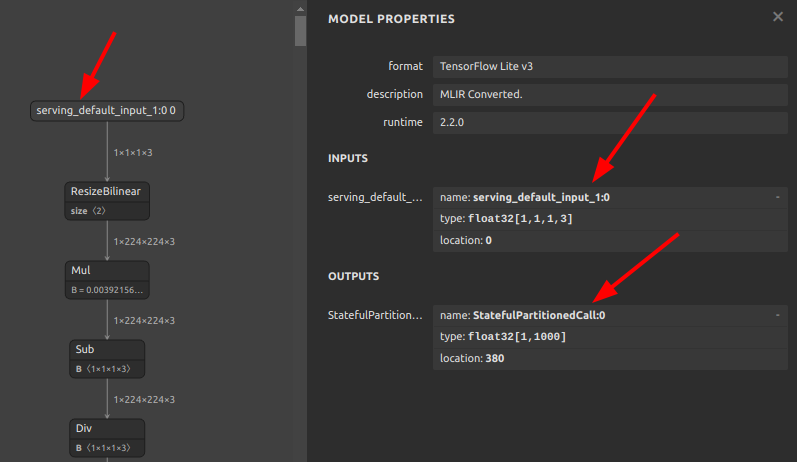
```bash
tfliteiorewriter \
-i xxxx.tflite \
-r serving_default_input_1:0 aaa \
-r StatefulPartitionedCall:0 bbb
```

- After

Click to expand
If you want to embed label maps, quantization parameters, descriptions, etc. into your tflite file, you can refer to the official tutorial and try it yourself. For now, this tool does not plan to implement the ability to append metadata, as I do not want to write byte arrays to the tflite file that are not essential to its operation.
- Adding metadata to TensorFlow Lite models
https://www.tensorflow.org/lite/models/convert/metadata

7. If the accuracy of the INT8 quantized model degrades significantly
Click to expand
It is a matter of model structure. The activation function (`SiLU`/`Swish`), kernel size and stride for `Pooling`, and kernel size and stride for `Conv` should be completely revised. See: https://github.com/PINTO0309/onnx2tf/issues/269
If you want to see the difference in quantization error between `SiLU` and `ReLU`, please check this Gist by [@motokimura](https://gist.github.com/motokimura) who helped us in our research. Thanks Motoki!
Gist: [Quantization error simulation of SiLU (Swish) activation](https://gist.github.com/motokimura/1a90c0b8c5628914b99a81cd91369636)
The accuracy error rates after quantization for different activation functions are shown in the figure below. The graph plots the distribution of absolute error, so a position with a higher value on the horizontal axis indicates a larger error. The vertical axis is the number of samples. `SiLU (Swish)` produces catastrophic errors after INT8 quantization.

- e.g. YOLOX-Nano
- https://github.com/motokimura/yolox-ti-lite_tflite
- https://github.com/TexasInstruments/edgeai-yolox
|Before|After|
|:-:|:-:|
|`Swish`/`SiLU`
|`ReLU`
|
|`DepthwiseConv2D`
|`Conv2D`
|
|`MaxPool`, kernel_size=5x5,9x9,13x13
|`MaxPool`, kernel_size=3x3
|
```
### Float32 - YOLOX-Nano
(1, 52, 52, 85)
array([[[
[ 0.971787, 0.811184, 0.550566, ..., -5.962632, -7.403673, -6.735206],
[ 0.858804, 1.351296, 1.231673, ..., -6.479690, -8.277064, -7.664936],
[ 0.214827, 1.035119, 1.458006, ..., -6.291425, -8.229385, -7.761562],
...,
[ 0.450116, 1.391900, 1.533354, ..., -5.672194, -7.121591, -6.880231],
[ 0.593133, 2.112723, 0.968755, ..., -6.150078, -7.370633, -6.874294],
[ 0.088263, 1.985220, 0.619998, ..., -5.507928, -6.914980, -6.234259]]]]),
### INT8 - YOLOX-Nano
(1, 52, 52, 85)
array([[[
[ 0.941908, 0.770652, 0.513768, ..., -5.993958, -7.449634, -6.850238],
[ 0.856280, 1.284420, 1.198792, ..., -6.507727, -8.391542, -7.792146],
[ 0.256884, 0.941908, 1.455676, ..., -6.336471, -8.305914, -7.877774],
...,
[ 0.342512, 1.370048, 1.541304, ..., -5.737075, -7.192750, -7.107122],
[ 0.513768, 2.226327, 1.027536, ..., -6.165215, -7.449634, -7.021494],
[ 0.085628, 2.055072, 0.685024, ..., -5.480191, -7.021494, -6.422099]]]]),
```
- Other recommended replacement OP
|Before|After|
|:-:|:-:|
|`HardSwish`
|`ReLU`
|
|`ReLU6`

Paper: [A Quantization-Friendly Separable Convolution for MobileNets](https://arxiv.org/pdf/1803.08607.pdf) https://arxiv.org/pdf/1803.08607.pdf|`ReLU`
|
- Quantization range collapse due to non-zero constant padding
If padding is performed with a constant other than zero, the padding value may destroy the quantization range of the input tensor. For example, the pattern is shown in the figure below. The `MaxPool2D` is done after padding the 4 sides of the input tensor with the minimum value of Float32. It seems that if INT8 quantization is performed with this structure, the quantization range is determined by `MaxPool2D` during quantization, including the values padded to the tensor. See: [#444](https://github.com/PINTO0309/onnx2tf/issues/444)
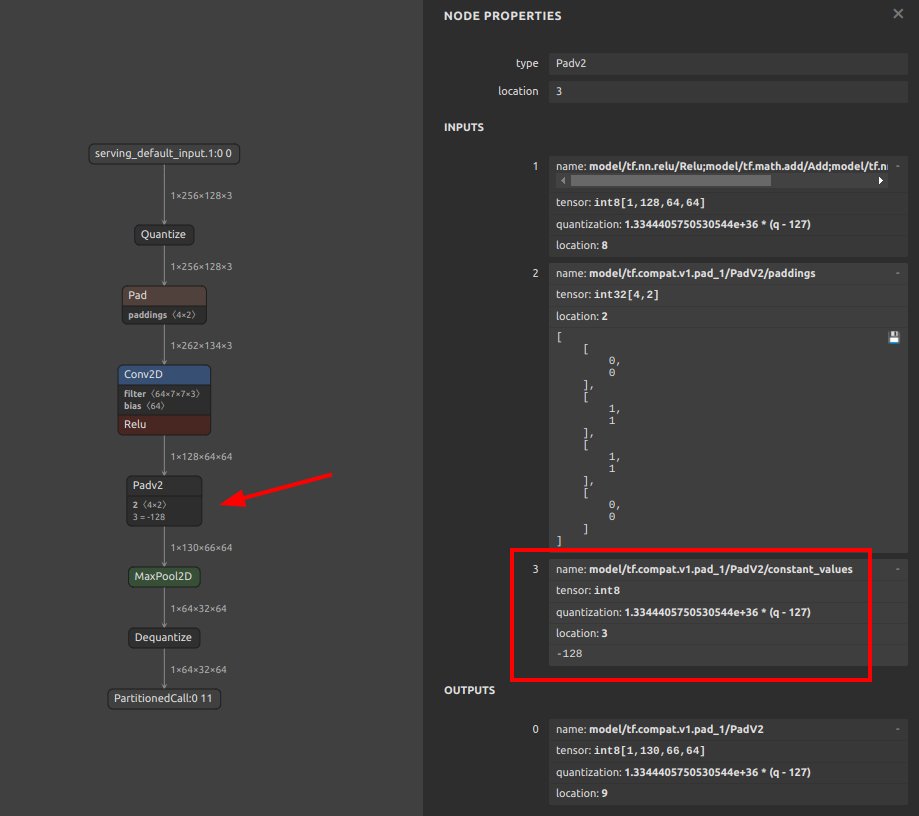
Therefore, the following two similar examples are equally likely to result in divergent output values for the model after INT8 quantization, with all output values being Nan or zero.
1. Pattern with fixed value `-255.0` padded on 4 sides of tensor
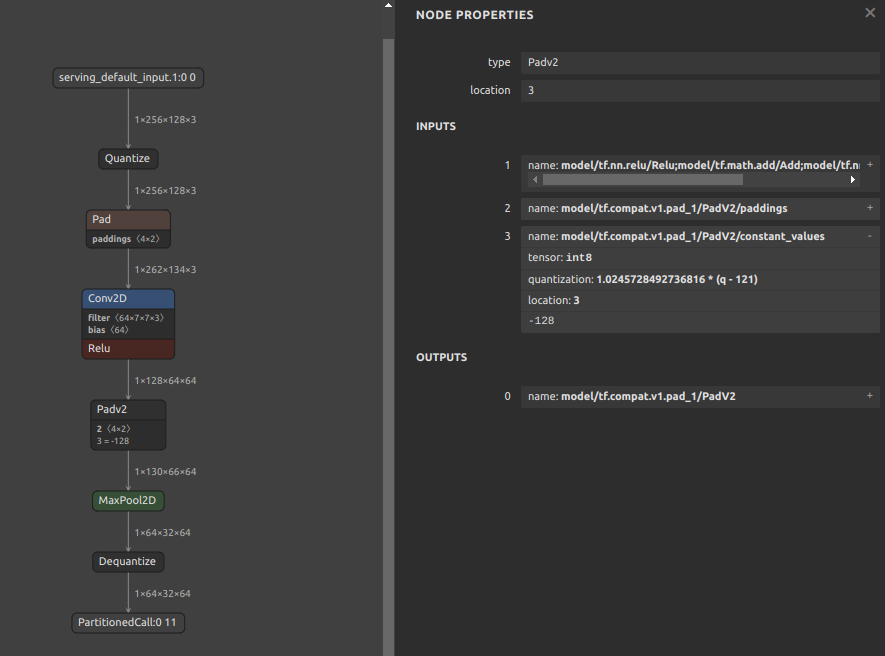
2. Pattern with fixed value `-128.0` padded on 4 sides of tensor

8. Calibration data creation for INT8 quantization
Click to expand
Calibration data (.npy) for INT8 quantization (`-cind`) is generated as follows. This is a sample when the data used for training is image data. See: https://github.com/PINTO0309/onnx2tf/issues/222
https://www.tensorflow.org/lite/performance/post_training_quantization
```python
import cv2
import glob
import numpy as np
# Not used during data generation ################################
# You will need to do the calculations yourself using the test data
MEAN = np.asarray([[[[0.485, 0.456, 0.406]]]], dtype=np.float32) # [1,1,1,3]
STD = np.asarray([[[[0.229, 0.224, 0.225]]]], dtype=np.float32) # [1,1,1,3]
# Not used during data generation ################################
files = glob.glob("data/*.png")
img_datas = []
for idx, file in enumerate(files):
bgr_img = cv2.imread(file)
rgb_img = cv2.cvtColor(bgr_img, cv2.COLOR_BGR2RGB)
resized_img = cv2.resize(rgb_img, dsize=(200,112))
extend_batch_size_img = resized_img[np.newaxis, :]
normalized_img = extend_batch_size_img / 255.0 # 0.0 - 1.0
print(
f'{str(idx+1).zfill(2)}. extend_batch_size_img.shape: {extend_batch_size_img.shape}'
) # [1,112,200,3]
img_datas.append(extend_batch_size_img)
calib_datas = np.vstack(img_datas)
print(f'calib_datas.shape: {calib_datas.shape}') # [10,112,200,3]
np.save(file='data/calibdata.npy', arr=calib_datas)
loaded_data = np.load('data/calibdata.npy')
print(f'loaded_data.shape: {loaded_data.shape}') # [10,112,200,3]
"""
-cind INPUT_NAME NUMPY_FILE_PATH MEAN STD
int8_calib_datas = (loaded_data - MEAN) / STD # -1.0 - 1.0
e.g. How to specify calibration data in CLI or Script respectively.
1. CLI
-cind "pc_dep" "data/calibdata.npy" "[[[[0.485,0.456,0.406]]]]" "[[[[0.229,0.224,0.225]]]]"
-cind "feat" "data/calibdata2.npy" "[[[[0.123,...,0.321]]]]" "[[[[0.112,...,0.451]]]]"
2. Script
custom_input_op_name_np_data_path=[
["pc_dep", "data/calibdata.npy", [[[[0.485,0.456,0.406]]]], [[[[0.229,0.224,0.225]]]]],
["feat", "data/calibdata2.npy", [[[[0.123,...,0.321]]]], [[[[0.112,...,0.451]]]],
]
"""
```
Click to expand
If you do not need to perform INT8 quantization with this tool alone, the following method is the easiest.
On the default `flatbuffer_direct` backend, combine `-fdosm` with `-osd` to output a `saved_model.pb` in the `saved_model` folder with the full size required for quantization. That is, a default signature named `serving_default` is embedded in `.pb`. If you need the legacy behavior instead, use `--tflite_backend tf_converter` explicitly. The `-b` option is used to convert the batch size by rewriting it as a static integer.
**Note: INT8 TFLite generated by following this procedure as is will result in a model with significantly degraded accuracy. This tutorial only demonstrates the INT8 quantization procedure; if you wish to correct for accuracy, please refer to [Parameter replacement](#parameter-replacement) to correct for transposition errors in the operation.**
```bash
# Ref: https://github.com/onnx/models/tree/main/text/machine_comprehension/bert-squad
wget https://s3.ap-northeast-2.wasabisys.com/temp-models/onnx2tf_248/bertsquad-12.onnx
onnx2tf -i bertsquad-12.onnx -b 1 -fdosm -osd -cotof
```

Use the `saved_model_cli` command to check the `saved_model` signature. INT8 quantization calibration using signatures allows correct control of the input order of data for calibration. Therefore, calibration with signatures is recommended for INT8 quantization of models with multiple inputs.
```bash
saved_model_cli show --dir saved_model/ --tag_set serve --signature_def serving_default
The given SavedModel SignatureDef contains the following input(s):
inputs['input_ids_0'] tensor_info:
dtype: DT_INT64
shape: (1, 256)
name: serving_default_input_ids_0:0
inputs['input_mask_0'] tensor_info:
dtype: DT_INT64
shape: (1, 256)
name: serving_default_input_mask_0:0
inputs['segment_ids_0'] tensor_info:
dtype: DT_INT64
shape: (1, 256)
name: serving_default_segment_ids_0:0
inputs['unique_ids_raw_output___9_0'] tensor_info:
dtype: DT_INT64
shape: (1)
name: serving_default_unique_ids_raw_output___9_0:0
```
Calibrate by specifying the input OP name displayed in `inputs`. The `np.ones([xxx], dtype=np.int64)` part must be replaced with the correct calibration test data. In practice, several pieces of data used for training are extracted and used.
```python
import tensorflow as tf
import numpy as np
def representative_dataset():
unique_ids = np.ones([10, 256], dtype=np.int64)
segment_ids = np.ones([10, 256], dtype=np.int64)
input_masks = np.ones([10, 256], dtype=np.int64)
input_ids = np.ones([10], dtype=np.int64)
for unique_id, segment_id, input_mask, input_id \
in zip(unique_ids, segment_ids, input_masks, input_ids):
yield {
"unique_ids_raw_output___9_0": unique_id,
"segment_ids_0": segment_id,
"input_mask_0": input_mask,
"input_ids_0": input_id,
}
converter = tf.lite.TFLiteConverter.from_saved_model('saved_model')
converter.optimizations = [tf.lite.Optimize.DEFAULT]
converter.representative_dataset = representative_dataset
converter.target_spec.supported_ops = [tf.lite.OpsSet.TFLITE_BUILTINS_INT8]
converter.inference_input_type = tf.int8 # or tf.uint8
converter.inference_output_type = tf.int8 # or tf.uint8
tflite_quant_model = converter.convert()
with open('saved_model/int8_model.tflite', 'wb') as w:
w.write(tflite_quant_model)
```

https://www.tensorflow.org/lite/performance/post_training_quantization
See: https://github.com/PINTO0309/onnx2tf/issues/248
10. Fixing the output of NonMaxSuppression (NMS)
Click to expand
PyTorch's `NonMaxSuppression (torchvision.ops.nms)` and ONNX's `NonMaxSuppression` are not fully compatible. TorchVision's NMS is very inefficient. Therefore, it is inevitable that converting ONNX using NMS in object detection models and other models will be very redundant and will be converted with a structure that is difficult for TensorFlow.js and TFLite models to take advantage of in devices. This is due to the indefinite number of tensors output by the NMS. In this chapter, I share how to easily tune the ONNX generated using TorchVision's redundant NMS to generate an optimized NMS.
1. There are multiple issues with TorchVision's NMS. First, the batch size specification is not supported; second, the `max_output_boxes_per_class` parameter cannot be specified. Please see the NMS sample ONNX part I generated. The `max_output_boxes_per_class` has been changed to `896` instead of `-Infinity`. The biggest problem with TorchVision NMS is that it generates ONNX with `max_output_boxes_per_class` set to `-Infinity` or `9223372036854775807 (Maximum value of INT64)`, resulting in a variable number of NMS outputs from zero to infinite. Thus, by rewriting `-Infinity` or `9223372036854775807 (Maximum value of INT64)` to a constant value, it is possible to output an NMS that can be effortlessly inferred by TFJS or TFLite.

Here you will find committed ONNX components optimized for various devices.
https://github.com/PINTO0309/components_of_onnx/tree/main/components_of_onnx/ops
2. In the following example, the `max_output_boxes_per_class` of NMS in the post-processing generated by YOLOv7 is changed from `-Infinity` or `9223372036854775807 (Maximum value of INT64)` to `20`, as shown in the figure below. The name `main01_max_output_boxes_per_class` has been rewritten by me for clarity, but it originally appears as `max_output_boxes_per_class`.

Simply execute the following command. The command rewrites the specified attribute value of the OP specified by ONNX.
```bash
pip install sam4onnx
sam4onnx \
--op_name main01_nonmaxsuppression11 \
--input_onnx_file_path yolov7.onnx \
--output_onnx_file_path nms_yolov7_update.onnx \
--input_constants main01_max_output_boxes_per_class int64 [20]
```
A tutorial on one of my ONNX modification tools, `sam4onnx`, can be found here.
https://github.com/PINTO0309/sam4onnx
Many detailed tutorials are provided below, so if you are interested, please play with them.
https://github.com/PINTO0309/PINTO_model_zoo/tree/main/307_YOLOv7/post_process_gen_tools
3. Finally, simply convert ONNX to TFLite or saved_model or TFJS using onnx2tf. onnx2tf performs an internal operation to automatically optimize the NMS output to a fixed shape if `max_output_boxes_per_class` is set to a value other than `-Infinity` and `9223372036854775807 (Maximum value of INT64)`. Specify `--output_nms_with_dynamic_tensor` or `-onwdt` if you do not want to optimize for a fixed shape. If you want to shrink class scores in NMS from `[B, C, N]` to `[B, 1, N]`, enable `--output_nms_with_argmax` or `-onwa`.
```
onnx2tf -i nms_yolov7_update.onnx -fdosm -osd -cotof
```
I would be happy if this is a reference for Android + Java or TFJS implementations. There are tons more tricky model optimization techniques described in my blog posts, so you'll have to find them yourself. I don't dare to list the URL here because it is annoying to see so many `issues` being posted. And unfortunately, all articles are in Japanese.

11. RNN (RNN, GRU, LSTM) Inference Acceleration
Click to expand
TensorFlow's RNN has a speedup option called `unroll`. The network will be unrolled, else a symbolic loop will be used. Unrolling can speed-up a RNN, although it tends to be more memory-intensive. Unrolling is only suitable for short sequences. onnx2tf allows you to deploy RNNs into memory-intensive operations by specifying the `--enable_rnn_unroll` or `-eru` options. The `--enable_rnn_unroll` option is available for `RNN`, `GRU`, and `LSTM`.
- Keras https://keras.io/api/layers/recurrent_layers/lstm/
- TensorFlow https://www.tensorflow.org/api_docs/python/tf/keras/layers/LSTM
An example of `BidirectionalLSTM` conversion with the `--enable_rnn_unroll` option is shown below. Please ignore that the shapes of the input and output tensors do not match, since the samples are shown by picking up separate models.
- ONNX `LSTM (Bidirectional)`

- `BidirectionalLSTM` with `--enable_rnn_unroll` option unspecified
Recurrent layer is implemented from scratch.

- `BidirectionalLSTM` with `--enable_rnn_unroll` option

12. If the accuracy of the Float32 model degrades significantly
Click to expand
The pattern of accuracy degradation of the converted model does not only occur when INT8 quantization is performed. A special edge case is when there is a problem with the implementation of a particular OP on the TFLite runtime side. Below, I will reproduce the problem by means of a very simple CNN model and further explain its workaround. Here is the issue that prompted me to add this explanation. [[Conv-TasNet] Facing issue in converting Conv-TasNet model #447](https://github.com/PINTO0309/onnx2tf/issues/447)
Download a sample model for validation.
```bash
curl \
-L https://github.com/PINTO0309/onnx2tf/files/12367312/prelu_check.onnx.zip \
-o prelu_check.onnx.zip
unzip prelu_check.onnx.zip
```
The part of the downloaded model where the problem occurs is the `PRelu` part in the figure below.
- ONNX

Reproduce the problem. The following command converts an ONNX file to a TFLite file.
```bash
onnx2tf -i prelu_check.onnx -cotof
```
The conversion was successful and, as shown in the figure below, the inference test results from ONNX and the inference results for the Float32 model in TensorFlow (Keras) match perfectly. It is important to note that the comparison of inference results between ONNX and TensorFlow transformed models is comparing ONNX models with TensorFlow (Keras) models, not ONNX models with TFLite models.
- Conversion results

- tflite

Now, let's try inference with the TFLite runtime instead of the TensorFlow runtime.
- `test.py`
```python
import time
import numpy as np
np.random.seed(0)
from ai_edge_litert.interpreter import Interpreter
# Load TFLite model
interpreter = Interpreter(model_path="./saved_model/prelu_check_float32.tflite")
interpreter.allocate_tensors()
tensor_shape = (256, 20)
input_data = {'waveform': np.random.randn(*tensor_shape).astype(np.float32)}
# Load and preprocess
input_details = interpreter.get_input_details()
input_shape = input_details[0]['shape']
print(input_shape)
# Run inference
interpreter.set_tensor(input_details[0]['index'], input_data["waveform"])
separate_time = time.time()
interpreter.invoke()
print("Done! {:.3f} s".format(time.time() - separate_time))
output_details = interpreter.get_output_details()
output_data = interpreter.get_tensor(output_details[0]['index'])
output_data = []
for output_detail in output_details:
output_data.append(interpreter.get_tensor(output_detail['index']))
print(output_data)
```
Oddly enough, the output value of `PReLU` contains multiple `nan`. However, as can be seen by converting the ONNX model to the middle of the model using the `-onimc` option, `nan` does not occur until just before `PReLU`. Thus, it is clear that the `PReLU` OP in the TFLite runtime has a problem with divergent inference results.
- TFLite inference results
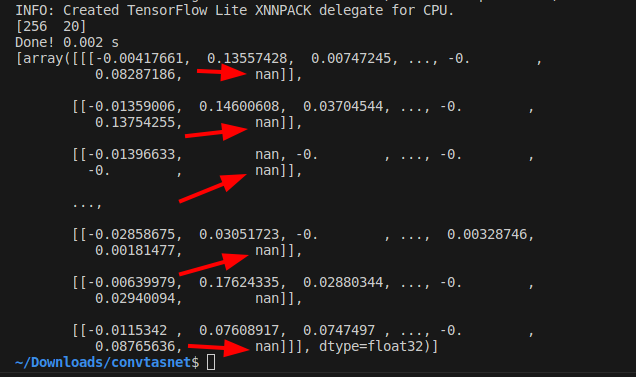
The following is a work-around to avoid this problem. Use the `-rtpo` option to replace `PReLU` with a similar primitive operation when transforming a model, and then perform the model transformation.
```bash
onnx2tf -i prelu_check.onnx -cotof -rtpo PReLU
```
As before, the inference results from ONNX and TensorFlow (Keras) match perfectly.
- Conversion results

However, `-rtpo PReLU` will generate a .tflite file with the `PRelu` OP replaced by a primitive OP combination.
- tflite

Again, run the test code to check the inference results. The figure below shows that no `nan` occurs when inference is performed by replacing the `PReLU` OP with only combinations of primitive operations. In other words, it is important to know that large arithmetic errors are not only due to the broken structure of the model, but can also be caused by internal implementations such as the TFLite runtime. I have implemented the `-rtpo` option to replace operators as a work-around to avoid such runtime problems.
- TFLite inference results
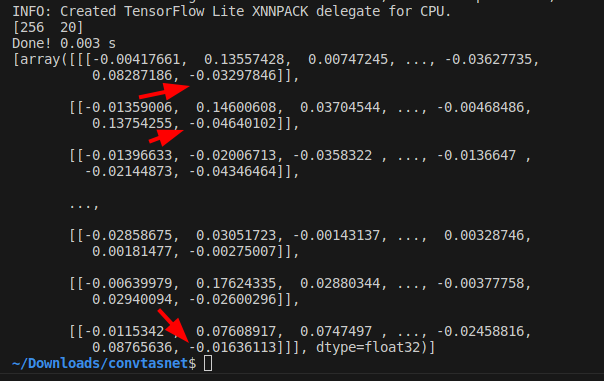
13. Problem of extremely large calculation error in InstanceNormalization
Click to expand
Even if the conversion is successful, `InstanceNormalization` tends to have very large errors. This is an ONNX specification.
- See.1: https://discuss.pytorch.org/t/understanding-instance-normalization-2d-with-running-mean-and-running-var/144139
- See.2: https://github.com/pytorch/pytorch/issues/72057
I verified this with a very simple sample model. There are more than 8 million elements, and the calculation error reached `1e-2`.
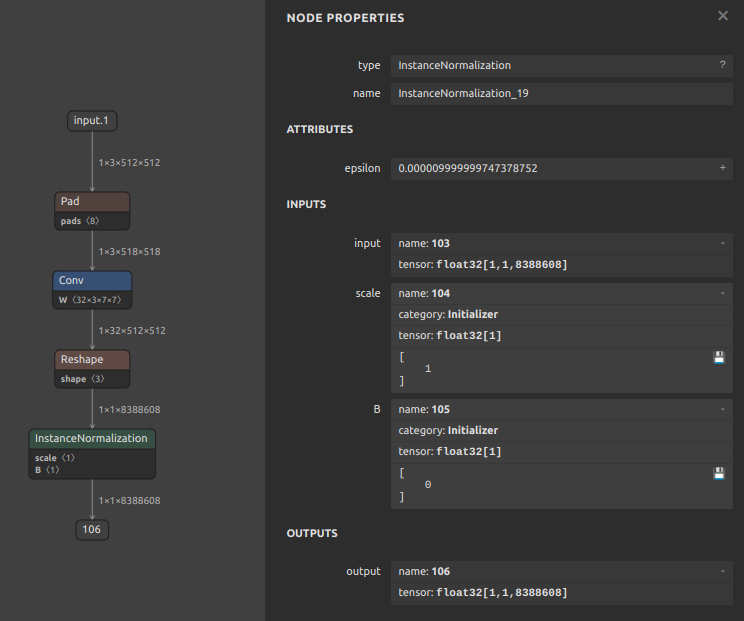

14. Inference with dynamic tensors in TFLite
Click to expand
For some time now, TFLite runtime has supported inference by dynamic tensors. However, the existence of this important function is not widely recognized. In this chapter, I will show how I can convert an ONNX file that contains dynamic geometry in batch size directly into a TFLite file that contains dynamic geometry and then further infer it in variable batch conditions. The issue that inspired me to add this tutorial is here. [[Dynamic batch / Dynamic shape] onnx model with dynamic input is converted to tflite with static input 1 #441](https://github.com/PINTO0309/onnx2tf/issues/441), or [Cannot use converted model with dynamic input shape #521](https://github.com/PINTO0309/onnx2tf/issues/521)
First, download the sample ONNX file.
```
wget https://s3.ap-northeast-2.wasabisys.com/temp-models/onnx2tf_441/osnet_x0_25_msmt17.onnx
```
This model calculates the similarity of features by cosine similarity. The batch size dimension of the input tensor is `batch`, allowing various numbers of images to be input simultaneously. This is often used, for example, to achieve tracking by calculating the similarity of people or objects reflected between successive video frames. However, the total number of objects to be tracked changes rapidly with each video frame because the number of people and objects in the image constantly increases and decreases. Therefore, there is a very significant use case for generating models with variable settings for the number of input images (batch size) of the model.

Convert the downloaded `OSNet` to `tflite` and `saved_model` as a variable batch. If you do not specify the `-b` or `-ois` options, onnx2tf does not change the batch size as `N`. The only important point is to convert the model with the `-osd` and `-coion` options.
```
onnx2tf -i osnet_x0_25_msmt17.onnx -fdosm -osd -coion
```
- `.tflite`
When viewing tflite in Netron, the batch size appears to be fixed at `1`.
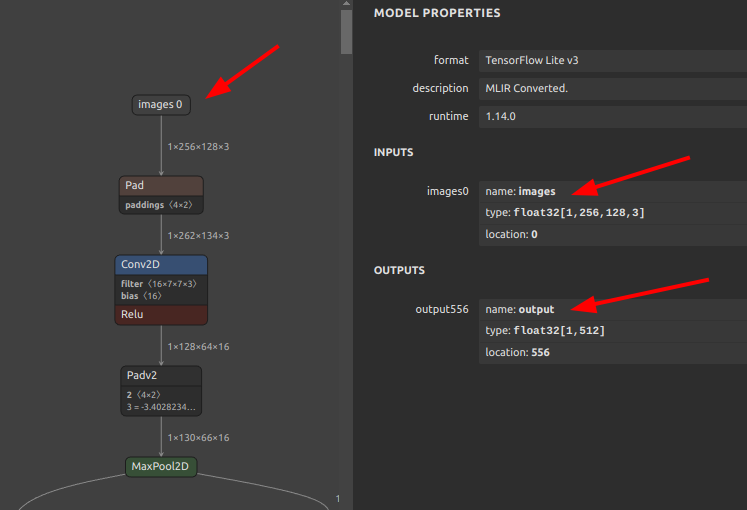
- `saved_model`
However, checking the structure of `saved_model`, the batch size is correctly set to `-1`.
```bash
saved_model_cli show --dir saved_model/ --all
MetaGraphDef with tag-set: 'serve' contains the following SignatureDefs:
signature_def['__saved_model_init_op']:
The given SavedModel SignatureDef contains the following input(s):
The given SavedModel SignatureDef contains the following output(s):
outputs['__saved_model_init_op'] tensor_info:
dtype: DT_INVALID
shape: unknown_rank
name: NoOp
Method name is:
signature_def['serving_default']:
The given SavedModel SignatureDef contains the following input(s):
inputs['images'] tensor_info:
dtype: DT_FLOAT
shape: (-1, 256, 128, 3)
name: serving_default_images:0
The given SavedModel SignatureDef contains the following output(s):
outputs['output'] tensor_info:
dtype: DT_FLOAT
shape: (-1, 512)
name: PartitionedCall:0
Method name is: tensorflow/serving/predict
```
To prove that the tflite structure has been converted correctly, I will convert the tflite to JSON and look at the structure.
(The `flatc` command below is only for manual inspection in the `tflite2json2tflite` container, not a requirement for onnx2tf conversion.)
```bash
docker run --rm -it \
-v `pwd`:/home/user/workdir \
ghcr.io/pinto0309/tflite2json2tflite:latest
./flatc -t \
--strict-json \
--defaults-json \
-o workdir \
./schema.fbs -- workdir/saved_model/osnet_x0_25_msmt17_float32.tflite
ls -l workdir
-rw-rw-r-- 1 user user 921564 Aug 4 10:24 osnet_x0_25_msmt17.onnx
-rw-r--r-- 1 user user 10369524 Aug 4 10:30 osnet_x0_25_msmt17_float32.json
drwxrwxr-x 4 user user 4096 Aug 4 10:26 saved_model
```
- `osnet_x0_25_msmt17_float32.json`
`"shape_signature"` is correctly set to `-1`. However, `"shape"` is set to `1`. This could be a problem with TFLiteConverter, or it could be a problem with Netron's graphical display capabilities.
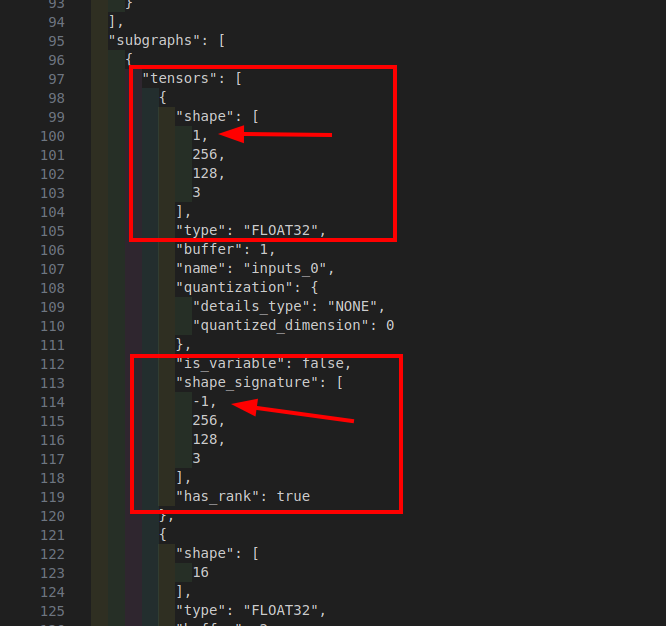
In other words, although onnx2tf converts TFLiteConverer as specified, with the batch size of `-1` without any model processing, only Netron's display is broken. This is a problem I have known for quite some time. However, the inference itself does not cause the problem.
If you want to infer in variable batches, you need to infer using `signature`. In such cases, the `-coion` option must be specified when converting the model. Note that I have identified a problem with quantization with the `-coion` option, which can corrupt tflite files. https://github.com/PINTO0309/onnx2tf/issues/429
https://github.com/PINTO0309/onnx2tf#4-match-tflite-inputoutput-names-and-inputoutput-order-to-onnx
You can use `signature_runner` to handle dynamic input tensors by performing inference using `signature`. Below I show that both `batch_size=5` and `batch_size=3` tensors can be inferred with the same model.
- `test.py` - Batch size: `5`
```python
import numpy as np
from ai_edge_litert.interpreter import Interpreter
from pprint import pprint
interpreter = Interpreter(model_path="saved_model/osnet_x0_25_msmt17_float32.tflite")
tf_lite_model = interpreter.get_signature_runner()
inputs = {
'images': np.ones([5,256,128,3], dtype=np.float32),
}
tf_lite_output = tf_lite_model(**inputs)
print(f"[TFLite] Model Predictions shape: {tf_lite_output['output'].shape}")
print(f"[TFLite] Model Predictions:")
pprint(tf_lite_output)
```
- Results
```
[TFLite] Model Predictions shape: (5, 512)
[TFLite] Model Predictions:
{'output': array([[0.0000000e+00, 2.4730086e-04, 0.0000000e+00, ..., 1.0528549e+00,
3.7874988e-01, 0.0000000e+00],
[0.0000000e+00, 2.4730086e-04, 0.0000000e+00, ..., 1.0528549e+00,
3.7874988e-01, 0.0000000e+00],
[0.0000000e+00, 2.4730086e-04, 0.0000000e+00, ..., 1.0528549e+00,
3.7874988e-01, 0.0000000e+00],
[0.0000000e+00, 2.4730086e-04, 0.0000000e+00, ..., 1.0528549e+00,
3.7874988e-01, 0.0000000e+00],
[0.0000000e+00, 2.4730084e-04, 0.0000000e+00, ..., 1.0528525e+00,
3.7874976e-01, 0.0000000e+00]], dtype=float32)}
```
- `test.py` - Batch size: `3`
```python
import numpy as np
from ai_edge_litert.interpreter import Interpreter
from pprint import pprint
interpreter = Interpreter(model_path="saved_model/osnet_x0_25_msmt17_float32.tflite")
tf_lite_model = interpreter.get_signature_runner()
inputs = {
'images': np.ones([3,256,128,3], dtype=np.float32),
}
tf_lite_output = tf_lite_model(**inputs)
print(f"[TFLite] Model Predictions shape: {tf_lite_output['output'].shape}")
print(f"[TFLite] Model Predictions:")
pprint(tf_lite_output)
```
- Results
```
[TFLite] Model Predictions shape: (3, 512)
[TFLite] Model Predictions:
{'output': array([[0.0000000e+00, 2.4730084e-04, 0.0000000e+00, ..., 1.0528525e+00,
3.7874976e-01, 0.0000000e+00],
[0.0000000e+00, 2.4730084e-04, 0.0000000e+00, ..., 1.0528525e+00,
3.7874976e-01, 0.0000000e+00],
[0.0000000e+00, 2.4730084e-04, 0.0000000e+00, ..., 1.0528525e+00,
3.7874976e-01, 0.0000000e+00]], dtype=float32)}
```
15. Significant optimization of the entire model through Einsum and OneHot optimizations
Click to expand
`Einsum` and `OneHot` are not optimized to the maximum by the standard behavior of onnx-optimizer. Therefore, pre-optimizing the `Einsum` OP and `OneHot` OP using my original method can significantly improve the success rate of model conversion, and the input ONNX model itself can be significantly optimized compared to when onnxsim alone is optimized. See: https://github.com/PINTO0309/onnx2tf/issues/569
- I have made a few unique customizations to the cited model structure.
https://github.com/PINTO0309/LightGlue-ONNX
- spo4onnx
https://github.com/PINTO0309/spo4onnx
For example
```
python export.py \
--img_size 512 512 \
--lightglue_path weights/sjy_fused_static.onnx \
--end2end
pip install -U spo4onnx onnx2tf
cd weights
spo4onnx -if sjy_fused_static.onnx -of sjy_fused_static_spo.onnx
onnx2tf -i sjy_fused_static_spo.onnx
```

16. Add constant outputs to the model that are not connected to the model body
Click to expand
Sometimes you want to always output constants that are not connected to the model body. See: [https://github.com/PINTO0309/onnx2tf/issues/627](https://github.com/PINTO0309/onnx2tf/issues/627). For example, in the case of ONNX as shown in the figure below. You may want to keep scaling parameters and other parameters as fixed values inside the model and always include the same value in the output.

In such cases, the process of optimizing the ONNX file in `onnxsim` must be bypassed and not executed. You can bypass the execution of `onnxsim` by specifying `-nuo` or `--not_use_onnxsim` as a conversion option. Running `onnxsim` will remove constants from the model definition that are not connected to the body of the model in the process of optimizing the model structure.
```bash
wget https://github.com/PINTO0309/onnx2tf/files/15292126/toy_with_constant.onnx.zip
unzip toy_with_constant.onnx.zip
onnx2tf -i toy_with_constant.onnx -nuo -cotof
```
The relationship between the ONNX before conversion and the TFLite file after conversion is shown in the figure below.
|ONNX|TFLite|
|:-:|:-:|
|||

Use the generated TFLite file to inference and ensure that it always contains fixed value output.
```python
from ai_edge_litert.interpreter import Interpreter
import numpy as np
from pprint import pprint
interpreter = Interpreter(model_path="saved_model/toy_with_constant_float32.tflite")
interpreter.allocate_tensors()
input_details = interpreter.get_input_details()
output_details = interpreter.get_output_details()
interpreter.set_tensor(
tensor_index=input_details[0]['index'],
value=np.ones(tuple(input_details[0]['shape']), dtype=np.float32)
)
interpreter.invoke()
variable_output = interpreter.get_tensor(output_details[0]['index'])
constant_output = interpreter.get_tensor(output_details[1]['index'])
print("=================")
print("Variable Output:")
pprint(variable_output)
print("=================")
print("Constant Output:")
pprint(constant_output)
```
```
=================
Variable Output:
array([[-0.02787317, -0.05505124, 0.05421712, 0.03526559, -0.14131774,
0.0019211 , 0.08399964, 0.00433664, -0.00984338, -0.03370604]],
dtype=float32)
=================
Constant Output:
array([1., 2., 3., 4., 5.], dtype=float32)
```
17. Conversion of models that use variable length tokens and embedding, such as LLM and sound models
Click to expand
This refers to a model with undefined dimensions, either all dimensions or multiple dimensions including batch size, as shown in the figure below.
- Sample model
https://github.com/PINTO0309/onnx2tf/releases/download/1.24.0/bge-m3.onnx
- Structure

If such a model is converted without any options, TensorFlow/Keras will abort. This is an internal TensorFlow/Keras implementation issue rather than an onnx2tf issue. TensorFlow/Keras does not allow more than two undefined dimensions in the `shape` attribute of `Reshape` due to the specification, so an error occurs during the internal transformation operation of the `Reshape` OP as shown below. This has been an inherent problem in TensorFlow/Keras since long ago and has not been resolved to this day. See: [RuntimeError: tensorflow/lite/kernels/range.cc:39 (start > limit && delta < 0) || (start < limit && delta > 0) was not true.Node number 3 (RANGE) failed to invoke. Node number 393 (WHILE) failed to invoke. current error :RuntimeError: tensorflow/lite/kernels/reshape.cc:55 stretch_dim != -1 (0 != -1)Node number 83 (RESHAPE) failed to prepare. #40504](https://github.com/tensorflow/tensorflow/issues/40504)
- OP where the problem occurs

- Error message
```
error: 'tf.Reshape' op requires 'shape' to have at most one dynamic dimension, but got multiple dynamic dimensions at indices 0 and 3
```
Thus, for models such as this, where all dimensions, including batch size, are dynamic shapes, it is often possible to convert by fixing the batch size to `1` with the `-b 1` or `--batch_size 1` option.
```
onnx2tf -i model.onnx -b 1 -fdosm -osd
```
- Results

When the converted tflite is displayed in Netron, all the dimensions of the dynamic shape are displayed as `1`, but this is a display problem in Netron, and the shape is actually converted to `-1` or `None`.

Click here to see how to perform inference using the dynamic shape tensor.
https://github.com/PINTO0309/onnx2tf/tree/main?tab=readme-ov-file#14-inference-with-dynamic-tensors-in-tflite
Click to expand
By specifying ONNX input or output names, only the middle part of the model can be converted. This is useful when you want to see what output is obtained in what part of the model after conversion, or when debugging the model conversion operation itself.
For example, take a model with multiple inputs and multiple outputs as shown in the figure below to try a partial transformation.

- To convert by specifying only the input name to start the conversion
```
wget https://github.com/PINTO0309/onnx2tf/releases/download/1.25.0/cf_fus.onnx
onnx2tf -i cf_fus.onnx -inimc 448 -coion
```

- To convert by specifying only the output name to end the conversion
```
wget https://github.com/PINTO0309/onnx2tf/releases/download/1.25.0/cf_fus.onnx
onnx2tf -i cf_fus.onnx -onimc dep_sec -coion
```

- To perform a conversion by specifying the input name to start the conversion and the output name to end the conversion
```
wget https://github.com/PINTO0309/onnx2tf/releases/download/1.25.0/cf_fus.onnx
onnx2tf -i cf_fus.onnx -inimc 448 -onimc velocity -coion
```

19. Conversion to TensorFlow.js
Click to expand
When converting to TensorFlow.js, process as follows.
```bash
pip install -U --no-deps \
tensorflowjs \
tensorflow_decision_forests \
ydf \
tensorflow_hub
onnx2tf -i mobilenetv2-12.onnx -ois input:1,3,224,224 -fdosm -osd -dgc
tensorflowjs_converter \
--input_format tf_saved_model \
--output_format tfjs_graph_model \
saved_model \
tfjs_model
```
See: https://github.com/tensorflow/tfjs/tree/master/tfjs-converter

20. Conversion to CoreML
Click to expand
When converting to CoreML, process as follows. The `-k` option is for conversion while maintaining the input channel order in ONNX's NCHW format.
```bash
pip install coremltools==8.2
onnx2tf -i mobilenetv2-12.onnx -k input -ois input:1,3,224,224 -fdosm -osd
```
```python
import coremltools as ct
FOLDER_PATH = 'saved_model'
model = ct.convert(
model=FOLDER_PATH,
source='tensorflow',
)
model.save(f'{FOLDER_PATH}/model.mlpackage')
```
See: https://github.com/apple/coremltools

CLI Parameter
Click to expand
```
onnx2tf -h
usage: onnx2tf
[-h]
(-i INPUT_ONNX_FILE_PATH | -it INPUT_TFLITE_FILE_PATH | -V)
[-o OUTPUT_FOLDER_PATH]
[-osd]
[-oh5]
[-okv3]
[-otfv1pb]
[-ow]
[-coion]
[-odrqt]
[-oiqt]
[-qt {per-channel,per-tensor}]
[-cind INPUT_NAME NUMPY_FILE_PATH MEAN STD]
[-iqd {int8,uint8,float32}]
[-oqd {int8,uint8,float32}]
[-npgts NATIVE_PYTORCH_GENERATION_TIMEOUT_SEC]
[-nuo]
[-nuonag]
[-b BATCH_SIZE]
[-ois OVERWRITE_INPUT_SHAPE [OVERWRITE_INPUT_SHAPE ...]]
[-sh SHAPE_HINTS [SHAPE_HINTS ...]]
[-nlt]
[-onwdt]
[-snms {v4,v5}]
[-k KEEP_NCW_OR_NCHW_OR_NCDHW_INPUT_NAMES [KEEP_NCW_OR_NCHW_OR_NCDHW_INPUT_NAMES ...]]
[-kt KEEP_NWC_OR_NHWC_OR_NDHWC_INPUT_NAMES [KEEP_NWC_OR_NHWC_OR_NDHWC_INPUT_NAMES ...]]
[-kat KEEP_SHAPE_ABSOLUTELY_INPUT_NAMES [KEEP_SHAPE_ABSOLUTELY_INPUT_NAMES ...]]
[-inimc INPUT_NAMES [INPUT_NAMES ...]]
[-onimc OUTPUT_NAMES [OUTPUT_NAMES ...]]
[-dgc]
[-eatfp16]
[-ebu]
[-eru]
[-dsft]
[-nodaftc]
[-dsfs]
[-dsm]
[-nodafsc]
[-ofgd]
[-rari64 | -rarf32 | -rafi64 | -raff32]
[-fasr FUSED_ARGMAX_SCALE_RATIO]
[-rtpo REPLACE_TO_PSEUDO_OPERATORS [REPLACE_TO_PSEUDO_OPERATORS ...]]
[-me MVN_EPSILON]
[-prf PARAM_REPLACEMENT_FILE]
[-cgdc]
[-coto | -cotof]
[-coton]
[-cotor CHECK_ONNX_TF_OUTPUTS_ELEMENTWISE_CLOSE_RTOL]
[-cotoa CHECK_ONNX_TF_OUTPUTS_ELEMENTWISE_CLOSE_ATOL]
[-tdnp TEST_DATA_NHWC_PATH]
[-agj]
[-dms]
[-uc]
[-n]
[-v]
optional arguments:
-h, --help
show this help message and exit
-i INPUT_ONNX_FILE_PATH, --input_onnx_file_path INPUT_ONNX_FILE_PATH
Input onnx file path.
-it INPUT_TFLITE_FILE_PATH, --input_tflite_file_path INPUT_TFLITE_FILE_PATH
Input tflite file path for direct import mode.
-V, --version
Show version and exit.
-o OUTPUT_FOLDER_PATH, --output_folder_path OUTPUT_FOLDER_PATH
Output folder path. Default: "saved_model"
-osd, --output_signaturedefs
Signature is added to the output for serving or for conversion
to other model formats. However, this can significantly reduce the speed
of model conversion and significant increase the size of the model.
-oh5, --output_h5
Output model in Keras (hdf5) format.
-okv3, --output_keras_v3
Output model in Keras (keras_v3) format.
-otfv1pb, --output_tfv1_pb
Output model in TF v1 (.pb) format.
-ow, --output_weights
Output weights in hdf5 format.
-coion, --copy_onnx_input_output_names_to_tflite
Copy the input/output OP name of ONNX to the input/output OP name of tflite.
Due to Tensorflow internal operating specifications,
the input/output order of ONNX does not necessarily match
the input/output order of tflite.
Be sure to check that the input/output OP names in the generated
tflite file have been converted as expected.
Also, this option generates a huge JSON file as a temporary file for processing.
Therefore, it is strongly discouraged to use it on large models of hundreds
of megabytes or more.
-odrqt, --output_dynamic_range_quantized_tflite
Output of dynamic range quantized tflite.
-oiqt, --output_integer_quantized_tflite
Output of integer quantized tflite.
-tb {tf_converter,flatbuffer_direct}, \
--tflite_backend {tf_converter,flatbuffer_direct}
TFLite generation backend.
"flatbuffer_direct"(default): Use direct FlatBuffer builder path (limited
OP/quantization support).
"tf_converter": Use TensorFlow Lite Converter as an explicit compatibility
path.
-fdosm, --flatbuffer_direct_output_saved_model
Output SavedModel directly from flatbuffer_direct ModelIR (float32).
Available only with --tflite_backend flatbuffer_direct.
Cannot be used with --disable_model_save.
Fails explicitly if CUSTOM ops are present.
With split output, partition SavedModels are emitted instead of a single root SavedModel.
-fdopt, --flatbuffer_direct_output_pytorch
Output a reloadable PyTorch package directly from flatbuffer_direct ModelIR.
Public spatial inputs/outputs use NCW/NCHW/NCDHW.
Unsupported/CUSTOM ops and residual channel-last layout bridges fail explicitly.
When used with -cotof, also outputs `
_pytorch_accuracy_report.json`
and `_accuracy_comparison_report.json` in the output directory.
With `-it/--input_tflite_file_path`, these reports compare `TFLite↔PyTorch`
using the same seeded inputs.
-fdots, --flatbuffer_direct_output_torchscript
Save a traced TorchScript file (`_jit.pt`) into the generated
flatbuffer_direct PyTorch package.
Requires `--tflite_backend flatbuffer_direct`.
Internally enables `--flatbuffer_direct_output_pytorch` automatically.
Only native PyTorch packages are supported. If the generated package falls
back to a non-native backend, conversion fails explicitly.
For dynamic public inputs, a concrete trace shape/input is required.
Recommended: `--shape_hints`
Also accepted: `--test_data_nhwc_path` for eligible 4D RGB inputs, or
`-cind` for per-input custom trace data.
-fdodo, --flatbuffer_direct_output_dynamo_onnx
Save a Dynamo ONNX file (`_dynamo.onnx`) into the generated
flatbuffer_direct PyTorch package using `torch.onnx.export(..., dynamo=True)`.
Requires `--tflite_backend flatbuffer_direct`.
Internally enables `--flatbuffer_direct_output_pytorch` automatically.
Only native PyTorch packages are supported. If the generated package falls
back to a non-native backend, conversion fails explicitly.
For dynamic public inputs, a concrete example input is required.
Recommended: `--shape_hints`
Also accepted: `--test_data_nhwc_path` for eligible 4D RGB inputs, or
`-cind` for per-input custom example data.
-fdoep, --flatbuffer_direct_output_exported_program
Save a PyTorch ExportedProgram file (`_ep.pt2`) into the
generated flatbuffer_direct PyTorch package using `torch.export.save`.
Requires `--tflite_backend flatbuffer_direct`.
Internally enables `--flatbuffer_direct_output_pytorch` automatically.
Only native PyTorch packages are supported. If the generated package falls
back to a non-native backend, conversion fails explicitly.
For dynamic public inputs, a concrete example input is required.
Recommended: `--shape_hints`
Also accepted: `--test_data_nhwc_path` for eligible 4D RGB inputs, or
`-cind` for per-input custom example data.
-qt {per-channel,per-tensor}, --quant_type {per-channel,per-tensor}
Selects whether "per-channel" or "per-tensor" quantization is used.
Default: "per-channel"
-qnm QUANT_NORM_MEAN, --quant_norm_mean QUANT_NORM_MEAN
Normalized average value during quantization.
Only valid when the "-cind" option is not used.
Default: "[[[[0.485, 0.456, 0.406]]]]"
-qns QUANT_NORM_STD, --quant_norm_std QUANT_NORM_STD
Normalized standard deviation during quantization.
Only valid when the "-cind" option is not used.
Default: "[[[[0.229, 0.224, 0.225]]]]"
-cind INPUT_NAME NUMPY_FILE_PATH MEAN STD, \
--custom_input_op_name_np_data_path INPUT_NAME NUMPY_FILE_PATH MEAN STD
Input name of OP and path of data file (Numpy) for custom input for -cotof, -fdots, -fdodo, -fdoep, or -oiqt,
and mean (optional) and std (optional).
Unlike -tdnp, this option supports per-input mapping, non-image tensors, and INT8 calibration.
<Usage in -cotof>
When using -cotof, custom input defined by the user, instead of dummy data, is used.
In this case, mean and std are omitted from the input.
-cind {input_op_name} {numpy_file_path}
e.g. -cind onnx::Equal_0 test_cind/x_1.npy -cind onnx::Add_1 test_cind/x_2.npy -cotof
The input_op_name must be the same as in ONNX,
and it may not work if the input format is different between ONNX and TF.
<Usage in -fdots / -fdodo / -fdoep>
When using -fdots, -fdodo, or -fdoep, -cind can be used to provide a concrete example input for a dynamic public input.
For shape-only hints, prefer --shape_hints. For 4D RGB inputs, --test_data_nhwc_path is also supported.
In these modes, mean and std are omitted from the input.
-cind {input_op_name} {numpy_file_path} -fdots
<Usage in -oiqt>
INPUT Name of OP and path of calibration data file (Numpy) for quantization
and mean and std.
This option is required when using -oiqt.
The type of the input OP must be Float32.
Data for calibration must be pre-normalized to a range of 0 to 1.
-cind {input_op_name} {numpy_file_path} {mean} {std}
Numpy file paths must be specified the same number of times as the number of input OPs.
Normalize the value of the input OP based on the tensor specified in mean and std.
(input_value - mean) / std
Tensors in Numpy file format must be in dimension order after conversion to TF.
Note that this is intended for deployment on low-resource devices,
so the batch size is limited to 1 only.
e.g.
The example below shows a case where there are three input OPs.
Assume input0 is 128x128 RGB image data.
In addition, input0 should be a value that has been divided by 255
in the preprocessing and normalized to a range between 0 and 1.
input1 and input2 assume the input of something that is not an image.
Because input1 and input2 assume something that is not an image,
the divisor is not 255 when normalizing from 0 to 1.
"n" is the number of calibration data.
ONNX INPUT shapes:
input0: [n,3,128,128]
mean: [1,3,1,1] -> [[[[0.485]],[[0.456]],[[0.406]]]]
std: [1,3,1,1] -> [[[[0.229]],[[0.224]],[[0.225]]]]
input1: [n,64,64]
mean: [1,64] -> [0.1, ..., 0.64]
std: [1,64] -> [0.05, ..., 0.08]
input2: [n,5]
mean: [1] -> [0.3]
std: [1] -> [0.07]
TensorFlow INPUT shapes (Numpy file ndarray shapes):
input0: [n,128,128,3]
mean: [1,1,1,3] -> [[[[0.485, 0.456, 0.406]]]]
std: [1,1,1,3] -> [[[[0.229, 0.224, 0.225]]]]
input1: [n,64,64]
mean: [1,64] -> [0.1, ..., 0.64]
std: [1,64] -> [0.05, ..., 0.08]
input2: [n,5]
mean: [1] -> [0.3]
std: [1] -> [0.07]
-cind "input0" "../input0.npy" "[[[[0.485,0.456,0.406]]]]" "[[[[0.229,0.224,0.225]]]]"
-cind "input1" "./input1.npy" "[0.1,...,0.64]" "[0.05,...,0.08]"
-cind "input2" "input2.npy" "[0.3]" "[0.07]"
<Using -cotof and -oiqt at the same time>
To use -cotof and -oiqt simultaneously,
you need to enter the Input name of OP, path of data file, mean, and std all together.
And the data file must be in Float32 format,
and {input_op_name}, {numpy_file_path}, {mean}, and {std} must all be entered.
Otherwise, an error will occur during the -oiqt stage.
-iqd {int8,uint8,float32}, --input_quant_dtype {int8,uint8,float32}
Input dtypes when doing Full INT8 Quantization.
"int8"(default) or "uint8" or "float32"
-oqd {int8,uint8,float32}, --output_quant_dtype {int8,uint8,float32}
Output dtypes when doing Full INT8 Quantization.
"int8"(default) or "uint8" or "float32"
-npgts NATIVE_PYTORCH_GENERATION_TIMEOUT_SEC, --native_pytorch_generation_timeout_sec NATIVE_PYTORCH_GENERATION_TIMEOUT_SEC
Timeout in seconds for generated native PyTorch package creation.
When exceeded, onnx2tf treats the generation as a recursion explosion,
aborts native PyTorch generation for the current model, and continues
conversion without PyTorch artifacts for that model.
`0` disables this timeout.
-nuo, --not_use_onnxsim
No optimization by onnx-simplifier is performed.
If this option is used, the probability of a conversion error is very high.
Effective for both `tf_converter` and `flatbuffer_direct` when converting
ONNX input. With `-it/--input_tflite_file_path` and
`--tflite_backend flatbuffer_direct`, this remains unsupported because
there is no ONNX preprocess stage.
-nuonag, --not_use_opname_auto_generate
Automatic generation of each OP name in the old format ONNX file
and assignment of OP name are not performed.
-b BATCH_SIZE, --batch_size BATCH_SIZE
Fixes the dynamic batch size to the specified numeric batch size.
A value of 1 or more must be specified.
-ois OVERWRITE_INPUT_SHAPE [OVERWRITE_INPUT_SHAPE ...], \
--overwrite_input_shape OVERWRITE_INPUT_SHAPE [OVERWRITE_INPUT_SHAPE ...]
Overwrite the input shape.
The format is
"i1:dim0,...,dimN" "i2:dim0,...,dimN" "i3:dim0,...,dimN"
When there is only one input, for example,
"data:1,3,224,224"
When there are multiple inputs, for example,
"data1:1,3,224,224" "data2:1,3,112" "data3:5"
A value of 1 or more must be specified.
Numerical values other than dynamic dimensions are ignored.
Ignores --batch_size if specified at the same time as --batch_size.
-sh SHAPE_HINTS [SHAPE_HINTS ...], \
--shape_hints SHAPE_HINTS [SHAPE_HINTS ...]
Shape hints for input tensors containing dynamic dimensions.
Specify input shapes for test inference with -cotof or -coto.
Unlike `--overwrite_input_shape`, this operation does not overwrite
the ONNX input shape with a static shape.
The format is
"i1:dim0,...,dimN" "i2:dim0,...,dimN" "i3:dim0,...,dimN"
When there is only one input, for example,
"data:1,3,224,224"
When there are multiple inputs, for example,
"data1:1,3,224,224" "data2:1,3,112" "data3:5"
A value of 1 or more must be specified.
Numerical values other than dynamic dimensions are ignored.
Also used as the recommended example-input hint source for -fdots,
-fdodo, and -fdoep.
-vh VALUE_HINTS [VALUE_HINTS ...], \
--value_hints VALUE_HINTS [VALUE_HINTS ...]
Value hints for dummy inference input tensors.
The format is
"input_name_1:value" "input_name_2:value" "*:default_value"
"*" applies to all inputs not explicitly specified.
Values are scalar only.
-nlt, --no_large_tensor
Suppresses constant bloat caused by Tile OP when optimizing models in onnxsim.
See: https://github.com/daquexian/onnx-simplifier/issues/178
-onwdt, --output_nms_with_dynamic_tensor
The number of bounding boxes in the NMS output results is
not fixed at the maximum number of max_output_boxes_per_class,
but rather at the smallest possible number of dynamic tensors.
If this option is disabled, NMS output is padded to the number
set in the max_output_boxes_per_class attribute.
e.g.
disable --output_nms_with_dynamic_tensor:
output_tensor_shape: [100, 7]
enable --output_nms_with_dynamic_tensor:
output_tensor_shape: [N, 7]
-onwa, --output_nms_with_argmax
Apply argmax to class scores dimension in NonMaxSuppression and shrink
scores tensor from [B, C, N] to [B, 1, N].
-snms {v4,v5}, --switch_nms_version {v4,v5}
Switch the NMS version to V4 or V5 to convert.
e.g.
NonMaxSuppressionV4(default): --switch_nms_version v4
NonMaxSuppressionV5: --switch_nms_version v5
-k KEEP_NCW_OR_NCHW_OR_NCDHW_INPUT_NAMES [KEEP_NCW_OR_NCHW_OR_NCDHW_INPUT_NAMES ...], \
--keep_ncw_or_nchw_or_ncdhw_input_names KEEP_NCW_OR_NCHW_OR_NCDHW_INPUT_NAMES \
[KEEP_NCW_OR_NCHW_OR_NCDHW_INPUT_NAMES ...]
Holds the NCW or NCHW or NCDHW of the input shape for the specified INPUT OP names.
If a nonexistent INPUT OP name is specified, it is ignored.
Valid only for 3D, 4D and 5D input tensors.
e.g. --keep_ncw_or_nchw_or_ncdhw_input_names "input0" "input1" "input2"
-kt KEEP_NWC_OR_NHWC_OR_NDHWC_INPUT_NAMES [KEEP_NWC_OR_NHWC_OR_NDHWC_INPUT_NAMES ...], \
--keep_nwc_or_nhwc_or_ndhwc_input_names KEEP_NWC_OR_NHWC_OR_NDHWC_INPUT_NAMES \
[KEEP_NWC_OR_NHWC_OR_NDHWC_INPUT_NAMES ...]
Holds the NWC or NHWC or NDHWC of the input shape for the specified INPUT OP names.
If a nonexistent INPUT OP name is specified, it is ignored.
If the input OP name is the same as the input OP name specified
in the keep_ncw_or_nchw_or_ncdhw_input_names option, it is ignored.
Valid only for 3D, 4D and 5D input tensors.
e.g. --keep_nwc_or_nhwc_or_ndhwc_input_names "input0" "input1" "input2"
-kat KEEP_SHAPE_ABSOLUTELY_INPUT_NAMES [KEEP_SHAPE_ABSOLUTELY_INPUT_NAMES ...], \
--keep_shape_absolutely_input_names KEEP_SHAPE_ABSOLUTELY_INPUT_NAMES \
[KEEP_SHAPE_ABSOLUTELY_INPUT_NAMES ...]
Name of the INPUT that unconditionally maintains its shape.
If a nonexistent INPUT OP name is specified, it is ignored.
e.g. --keep_shape_absolutely_input_names "input0" "input1" "input2"
-inimc INPUT_NAMES [INPUT_NAMES ...], \
--input_names_to_interrupt_model_conversion INPUT_NAMES [INPUT_NAMES ...]
Input names of ONNX that interrupt model conversion.
Interrupts model transformation at the specified input name and inputs the
model partitioned into subgraphs.
With `--tflite_backend flatbuffer_direct`, this crops ModelIR and treats
the specified tensors as runtime inputs.
e.g. --input_names_to_interrupt_model_conversion "input0" "input1" "input2"
-onimc OUTPUT_NAMES [OUTPUT_NAMES ...], \
--output_names_to_interrupt_model_conversion OUTPUT_NAMES [OUTPUT_NAMES ...]
Output names of ONNX that interrupt model conversion.
Interrupts model transformation at the specified output name and outputs the
model partitioned into subgraphs.
With `--tflite_backend flatbuffer_direct`, this crops ModelIR and treats
the specified tensors as runtime outputs.
e.g. --output_names_to_interrupt_model_conversion "output0" "output1" "output2"
-easm, --enable_auto_split_model
Force auto split regardless of the ONNX file size.
Uses --auto_split_max_size as the target partition size.
In `flatbuffer_direct`, this forces the shared ModelIR split planner to run and
emit split manifest outputs even if the size estimate would otherwise fit in one partition.
-asms AUTO_SPLIT_MAX_SIZE, --auto_split_max_size AUTO_SPLIT_MAX_SIZE
Target maximum size per partition when auto-split is triggered or forced.
Supported units: KB, MB, GB (e.g. 900MB, 1GB, 1536KB).
Bare numbers are treated as MB.
When specified, this value is also used as the target size for --enable_auto_split_model.
Default: 1GB
-esm {unsplit_tflite,onnx}, --eval_split_models {unsplit_tflite,onnx}
Evaluate split partitions sequentially using split manifest output.
Specify `unsplit_tflite` to compare against the unsplit/base TFLite model,
or `onnx` to compare against ONNX Runtime output.
Available only with `--tflite_backend flatbuffer_direct`
and requires `--enable_auto_split_model`.
Writes `*_split_accuracy_report.json`.
`*_accuracy_report.json` remains the unsplit base float32 TFLite vs ONNX report.
-dgc, --disable_group_convolution
Disable GroupConvolution and replace it with SeparableConvolution for
conversion outputs.
This option is applied in both tf_converter and flatbuffer_direct paths.
In `flatbuffer_direct`, ONNX input keeps using direct grouped-conv lowering
control, and `-it/--input_tflite_file_path` rewrites imported grouped
`CONV_2D` to `SPLIT` + per-group `CONV_2D` + `CONCATENATION`.
-eatfp16, --enable_accumulation_type_float16 ENABLE_ACCUMULATION_TYPE_FLOAT16
Hint for XNNPACK fp16 inference on float16 tflite model.
XNNPACK float16 inference on certain ARM64 cores is 2x faster.
Float16 inference doubling on devices with ARM64 ARMv8.2 or higher instruction set.
This option is applied in both tf_converter and flatbuffer_direct paths.
See: https://github.com/PINTO0309/onnx2tf/pull/553
-ebu, --enable_batchmatmul_unfold
BatchMatMul is separated batch by batch to generate a primitive MatMul.
In `flatbuffer_direct`, this rewrites ModelIR `BATCH_MATMUL` ops with
static batch prefixes into per-batch slices plus rank-lowered matmul ops.
This is available for both ONNX input and `-it/--input_tflite_file_path`.
-eru, --enable_rnn_unroll
Instead of increasing inference speed by expanding all symbolic loops of
the RNN (LSTM, GRU, RNN), RAM consumption will increase because all tensors
are expanded and embedded in the model.
In `flatbuffer_direct`, this rewrites supported sequence RNN/LSTM ModelIR
ops into step-unrolled primitive ops for both ONNX input and
`-it/--input_tflite_file_path`. `GRU` already uses step-style lowering in
the direct path.
https://keras.io/api/layers/recurrent_layers/
-dsft, --disable_suppression_flextranspose
Disables FlexTranspose generation suppression.
With `--tflite_backend flatbuffer_direct` on ONNX input, this emits a
single builtin `TRANSPOSE` without rank-compression. With
`-it/--input_tflite_file_path`, this option remains unsupported.
-nodaftc, --number_of_dimensions_after_flextranspose_compression
Number of Transpose OP dimensions generated after avoiding FlexTranspose generation.
Also suppress the creation of the Transpose itself by specifying 2.
Default: 6
-dsfs, --disable_suppression_flexstridedslice
Disables FlexStridedSlice generation suppression.
With `--tflite_backend flatbuffer_direct` on ONNX input, this emits a
single builtin `SLICE`/`STRIDED_SLICE` without rank-compression. With
`-it/--input_tflite_file_path`, this option remains unsupported.
-dsm, --disable_strict_mode
If specified, the conversion speed is greatly accelerated because the strict accuracy
correction process is skipped, but the frequency of transposition errors increases
and accuracy errors are more likely to occur. Strict mode is enabled by default.
As of 2023.05.07, this is a work in progress and is an experimental feature.
Therefore, only some OPs are converted in strict mode for accuracy correction.
-nodafsc, --number_of_dimensions_after_flexstridedslice_compression
Number of StridedSlice OP dimensions generated after avoiding FlexStridedSlice generation.
Default: 5
-ofgd, --optimization_for_gpu_delegate
Replace operations that do not support gpu delegate with those
that do as much as possible.
Effective in both `tf_converter` and `flatbuffer_direct` for ONNX input.
In `flatbuffer_direct`, this now applies direct lowering rewrites for
broadcast arithmetic, Gather negative-index normalization, and Gemm bias
handling. With `-it/--input_tflite_file_path`, this option remains
unsupported.
-rari64, --replace_argmax_to_reducemax_and_indices_is_int64
Replace ArgMax with a ReduceMax. The returned indices are int64.
Effective in both `tf_converter` and `flatbuffer_direct` for ONNX input.
With `-it/--input_tflite_file_path`, this option remains unsupported.
Only one of replace_argmax_to_reducemax_and_indices_is_int64
and replace_argmax_to_reducemax_and_indices_is_float32
and replace_argmax_to_fused_argmax_and_indices_is_int64
and replace_argmax_to_fused_argmax_and_indices_is_float32 can be specified.
-rarf32, --replace_argmax_to_reducemax_and_indices_is_float32
Replace ArgMax with a ReduceMax. The returned indices are float32.
Effective in both `tf_converter` and `flatbuffer_direct` for ONNX input.
With `-it/--input_tflite_file_path`, this option remains unsupported.
Only one of replace_argmax_to_reducemax_and_indices_is_int64
and replace_argmax_to_reducemax_and_indices_is_float32
and replace_argmax_to_fused_argmax_and_indices_is_int64
and replace_argmax_to_fused_argmax_and_indices_is_float32 can be specified.
-rafi64, --replace_argmax_to_fused_argmax_and_indices_is_int64
Replace ArgMax with a Fused_ArgMax. The returned indices are int64.
It improves inference speed at the cost of a small sacrifice in accuracy.
See. https://github.com/tensorflow/models/tree/master/official/projects/edgetpu/vision#argmax-fusion-to-improve-segmentation-model-latency
Currently, only 4D tensors are supported.
Effective in both `tf_converter` and `flatbuffer_direct` for ONNX input.
In `flatbuffer_direct`, this currently targets `Resize -> ArgMax` 4D
patterns. With `-it/--input_tflite_file_path`, this option remains
unsupported.
Only one of replace_argmax_to_reducemax_and_indices_is_int64
and replace_argmax_to_reducemax_and_indices_is_float32
and replace_argmax_to_fused_argmax_and_indices_is_int64
and replace_argmax_to_fused_argmax_and_indices_is_float32 can be specified.
-raff32, --replace_argmax_to_fused_argmax_and_indices_is_float32
Replace ArgMax with a Fused_ArgMax. The returned indices are float32.
It improves inference speed at the cost of a small sacrifice in accuracy.
See. https://github.com/tensorflow/models/tree/master/official/projects/edgetpu/vision#argmax-fusion-to-improve-segmentation-model-latency
Currently, only 4D tensors are supported.
Effective in both `tf_converter` and `flatbuffer_direct` for ONNX input.
In `flatbuffer_direct`, this currently targets `Resize -> ArgMax` 4D
patterns. With `-it/--input_tflite_file_path`, this option remains
unsupported.
Only one of replace_argmax_to_reducemax_and_indices_is_int64
and replace_argmax_to_reducemax_and_indices_is_float32
and replace_argmax_to_fused_argmax_and_indices_is_int64
and replace_argmax_to_fused_argmax_and_indices_is_float32 can be specified.
-fasr FUSED_ARGMAX_SCALE_RATIO, --fused_argmax_scale_ratio FUSED_ARGMAX_SCALE_RATIO
For Fused ArgMax.
Scale ratio when generating Fused ArgMax.
0.0 < fused_argmax_scale_ratio <= 1.0
Default: 0.5
-rtpo, --replace_to_pseudo_operators
Replace list of operators to pseudo operators.
Full name of the target operators should be given.
Currently supported operators :
Asin, Acos, Atan, Abs, PReLU, LeakyReLU, Power, GatherND, Neg, HardSwish, Erf, GeLU, MatMulInteger, Inverse
Note: Inverse is pseudo-lowered by default. Specifying Inverse keeps MatrixInverse/FlexMatrixInverse.
-me, --mvn_epsilon
For MeanVarianceNormalization.
The number to be added to the variance to avoid division by zero
when normalizing the value.
(input_tensor - mean) / tf.sqrt(variance + mvn_epsilon)
Effective in both `tf_converter` and `flatbuffer_direct` for ONNX input.
Default: 0.0000000001
-prf PARAM_REPLACEMENT_FILE, --param_replacement_file PARAM_REPLACEMENT_FILE
Parameter replacement file path. (.json)
-cgdc, --check_gpu_delegate_compatibility
Run TFLite ModelAnalyzer on the generated Float16 tflite model
to check if the model can be supported by GPU Delegate.
e.g.
"""
=== TFLite ModelAnalyzer ===
Your TFLite model has '1' subgraph(s). In the subgraph description below,
T# represents the Tensor numbers. For example, in Subgraph#0, the RESHAPE op takes
tensor #0 and tensor #6 as input and produces tensor #7 as output.
Subgraph#0 main(T#0) -> [T#17]
Op#0 RESHAPE(T#0, T#6[2, 8, 8, 3, 2, ...]) -> [T#7]
Op#1 SPLIT(T#5[0], T#7) -> [T#8, T#9]
Op#2 RESHAPE(T#8, T#1[8, 8, 3, 2, 2]) -> [T#10]
Op#3 TRANSPOSE(T#10, T#4[0, 3, 1, 4, 2]) -> [T#11]
Op#4 RESHAPE(T#11, T#2[1, 8, 2, 8, 2, ...]) -> [T#12]
Op#5 RESHAPE(T#9, T#1[8, 8, 3, 2, 2]) -> [T#13]
Op#6 TRANSPOSE(T#13, T#4[0, 3, 1, 4, 2]) -> [T#14]
Op#7 RESHAPE(T#14, T#2[1, 8, 2, 8, 2, ...]) -> [T#15]
Op#8 CONCATENATION(T#12, T#15) -> [T#16]
Op#9 RESHAPE(T#16, T#3[2, 16, 16, 3]) -> [T#17]
Tensors of Subgraph#0
T#0(inputs_0) shape:[2, 8, 8, 12], type:FLOAT32
T#1(model/tf.compat.v1.squeeze_2/Squeeze) shape:[5], type:INT32 RO 20 bytes, data:[8, 8, 3, 2, 2]
T#2(model/tf.expand_dims_1/ExpandDims) shape:[6], type:INT32 RO 24 bytes, data:[1, 8, 2, 8, 2, ...]
T#3(model/tf.reshape_1/Reshape/shape) shape:[4], type:INT32 RO 16 bytes, data:[2, 16, 16, 3]
T#4(model/tf.compat.v1.transpose/transpose/perm) shape:[5], type:INT32 RO 20 bytes, data:[0, 3, 1, 4, 2]
T#5(model/tf.concat/concat/axis) shape:[], type:INT32 RO 4 bytes, data:[0]
T#6(model/tf.reshape/Reshape/shape) shape:[6], type:INT32 RO 24 bytes, data:[2, 8, 8, 3, 2, ...]
T#7(model/tf.reshape/Reshape) shape:[2, 8, 8, 3, 2, 2], type:FLOAT32
T#8(model/tf.split/split) shape:[1, 8, 8, 3, 2, 2], type:FLOAT32
T#9(model/tf.split/split1) shape:[1, 8, 8, 3, 2, 2], type:FLOAT32
T#10(model/tf.compat.v1.squeeze_1/Squeeze) shape:[8, 8, 3, 2, 2], type:FLOAT32
T#11(model/tf.compat.v1.transpose/transpose) shape:[8, 2, 8, 2, 3], type:FLOAT32
T#12(model/tf.expand_dims/ExpandDims) shape:[1, 8, 2, 8, 2, 3], type:FLOAT32
T#13(model/tf.compat.v1.squeeze_2/Squeeze1) shape:[8, 8, 3, 2, 2], type:FLOAT32
T#14(model/tf.compat.v1.transpose_1/transpose) shape:[8, 2, 8, 2, 3], type:FLOAT32
T#15(model/tf.expand_dims_1/ExpandDims1) shape:[1, 8, 2, 8, 2, 3], type:FLOAT32
T#16(model/tf.concat/concat) shape:[2, 8, 2, 8, 2, 3], type:FLOAT32
T#17(Identity) shape:[2, 16, 16, 3], type:FLOAT32
Your model looks compatibile with GPU delegate with TFLite runtime version 2.10.0.
But it doesn't guarantee that your model works well with GPU delegate.
There could be some runtime incompatibililty happen.
---------------------------------------------------------------
Model size: 2988 bytes
Non-data buffer size: 2757 bytes (92.27 %)
Total data buffer size: 231 bytes (07.73 %)
(Zero value buffers): 4 bytes (00.13 %)
* Buffers of TFLite model are mostly used for constant tensors.
And zero value buffers are buffers filled with zeros.
Non-data buffers area are used to store operators, subgraphs and etc.
You can find more details from https://github.com/google-ai-edge/LiteRT/blob/v2.1.2/tflite/converter/schema/schema.fbs
"""
-coto, --check_onnx_tf_outputs_elementwise_close
Returns "Matches" if the output of onnx and the output of TF are
within acceptable proximity element by element.
Returns "Unmatched" if the output of onnx and the output of TF are
not within acceptable proximity element by element.
If the output of onnx is 1D, it returns "Skipped" and skips the comparison
between the output of onnx and that of TF. This is because when undefined
dimensions are present, a situation often arises where very large index
values are compared, causing OutOfMemory.
Only the output content of the models final output OP is checked.
-cotof, --check_onnx_tf_outputs_elementwise_close_full
Returns "Matches" if the output of onnx and the output of TF are
within acceptable proximity element by element.
Check the output of all OPs in sequence from the beginning,
including all but the final output OP of the model.
Returns "Unmatched" if the output of onnx and the output of TF are
not within acceptable proximity element by element.
If the output of onnx is 1D, it returns "Skipped" and skips the comparison
between the output of onnx and that of TF. This is because when undefined
dimensions are present, a situation often arises where very large index
values are compared, causing OutOfMemory.
It is very time consuming because it performs as many inferences as
there are operations.
With `--tflite_backend flatbuffer_direct`, this uses the TensorFlow-free
ONNX/TFLite comparison path. The base report is
`_accuracy_report.json` (`ONNX↔TFLite`).
If `--flatbuffer_direct_output_pytorch` is also enabled, onnx2tf additionally
emits `_pytorch_accuracy_report.json` (`ONNX↔PyTorch`) and
`_accuracy_comparison_report.json` using the same input samples.
When `--input_tflite_file_path` is specified together with
`--flatbuffer_direct_output_pytorch`, onnx2tf emits
`_pytorch_accuracy_report.json` (`TFLite↔PyTorch`) and
`_accuracy_comparison_report.json`.
-coton, --check_onnx_tf_outputs_sample_data_normalization
norm: Validate using random data normalized to the range 0.0 to 1.0
denorm: Validate using random data in the range 0.0 to 255.0
If there is a normalization layer at the model's entry point, or
if the model was trained on denormalized data, "denorm" must be specified.
Default: "norm"
-cotor CHECK_ONNX_TF_OUTPUTS_ELEMENTWISE_CLOSE_RTOL,\
--check_onnx_tf_outputs_elementwise_close_rtol CHECK_ONNX_TF_OUTPUTS_ELEMENTWISE_CLOSE_RTOL
The relative tolerance parameter.
Default: 0.0
-cotoa CHECK_ONNX_TF_OUTPUTS_ELEMENTWISE_CLOSE_ATOL,\
--check_onnx_tf_outputs_elementwise_close_atol CHECK_ONNX_TF_OUTPUTS_ELEMENTWISE_CLOSE_ATOL
The absolute tolerance parameter.
Default: 1e-4
-tdnp TEST_DATA_NHWC_PATH, --test_data_nhwc_path TEST_DATA_NHWC_PATH
Path to a numpy file (.npy) containing custom test data in NHWC format.
This is used for test inference and validation when check_onnx_tf_outputs options are enabled.
The numpy array should have shape [batch_size, height, width, 3] with values
normalized to the range [0, 1].
This option is useful for offline environments or when you want to use
specific test data for validation.
It is also accepted by -fdots, -fdodo, and -fdoep for 4D RGB image inputs.
For models with multiple inputs, the same test array is reused for each eligible input
after per-input resize/layout conversion.
Unlike -cind, this option is not used for INT8 calibration and does not accept mean/std.
-agj, --auto_generate_json
Automatically generates a parameter replacement JSON file that achieves minimal error
when converting the model. This option explores various parameter combinations to find
the best settings that result in successful conversion and highest accuracy.
The search stops when the final output OP accuracy check shows "Matches".
When used together with -cotof, the generated JSON is used to re-evaluate accuracy.
WARNING: This option performs an exhaustive search to find the optimal conversion patterns,
which can take a very long time depending on the model complexity.
-agje, --auto_generate_json_on_error
Attempts to generate a parameter replacement JSON when conversion fails or when accuracy
validation finds errors greater than 1e-2. Useful for quickly capturing fixes during
-cotof runs. Disabled by default to avoid unexpected file generation.
-dms, --disable_model_save
Does not save the converted model. For CIs RAM savings.
-n, --non_verbose
Shorthand to specify a verbosity of "error".
-v, --verbosity
Change the level of information printed.
Values are "debug", "info", "warn", and "error".
Default: "debug" (for backwards compatability)
```
</div></details>
## In-script Usage
Click to expand
```python
>>> from onnx2tf import convert
>>> help(convert)
Help on function convert in module onnx2tf:
convert(
input_onnx_file_path: Union[str, NoneType] = '',
input_tflite_file_path: Union[str, NoneType] = '',
onnx_graph: Union[onnx.onnx_ml_pb2.ModelProto, NoneType] = None,
output_folder_path: Union[str, NoneType] = 'saved_model',
output_signaturedefs: Optional[bool] = False,
output_h5: Optional[bool] = False,
output_keras_v3: Optional[bool] = False,
output_tfv1_pb: Optional[bool] = False,
output_weights: Optional[bool] = False,
copy_onnx_input_output_names_to_tflite: Optional[bool] = False,
output_integer_quantized_tflite: Optional[bool] = False,
flatbuffer_direct_output_saved_model: Optional[bool] = False,
flatbuffer_direct_output_pytorch: Optional[bool] = False,
flatbuffer_direct_output_torchscript: Optional[bool] = False,
flatbuffer_direct_output_dynamo_onnx: Optional[bool] = False,
flatbuffer_direct_output_exported_program: Optional[bool] = False,
native_pytorch_generation_timeout_sec: Optional[int] = 0,
tflite_backend: Optional[str] = 'flatbuffer_direct',
quant_norm_mean: Optional[str] = '[[[[0.485, 0.456, 0.406]]]]',
quant_norm_std: Optional[str] = '[[[[0.229, 0.224, 0.225]]]]',
quant_type: Optional[str] = 'per-channel',
custom_input_op_name_np_data_path: Optional[List] = None,
input_quant_dtype: Optional[str] = 'int8',
output_quant_dtype: Optional[str] = 'int8',
not_use_onnxsim: Optional[bool] = False,
not_use_opname_auto_generate: Optional[bool] = False,
batch_size: Union[int, NoneType] = None,
overwrite_input_shape: Union[List[str], NoneType] = None,
shape_hints: Union[List[str], NoneType] = None,
value_hints: Union[List[str], NoneType] = None,
no_large_tensor: Optional[bool] = False,
output_nms_with_dynamic_tensor: Optional[bool] = False,
output_nms_with_argmax: Optional[bool] = False,
switch_nms_version: Optional[str] = 'v4',
keep_ncw_or_nchw_or_ncdhw_input_names: Union[List[str], NoneType] = None,
keep_nwc_or_nhwc_or_ndhwc_input_names: Union[List[str], NoneType] = None,
keep_shape_absolutely_input_names: Optional[List[str]] = None,
input_names_to_interrupt_model_conversion: Union[List[str], NoneType] = None,
output_names_to_interrupt_model_conversion: Union[List[str], NoneType] = None,
enable_auto_split_model: Optional[bool] = False,
auto_split_max_size: Union[Any, NoneType] = None,
auto_split_max_size_mb: Union[int, NoneType] = None,
disable_group_convolution: Union[bool, NoneType] = False,
enable_batchmatmul_unfold: Optional[bool] = False,
enable_rnn_unroll: Optional[bool] = False,
disable_suppression_flextranspose: Optional[bool] = False,
number_of_dimensions_after_flextranspose_compression: Optional[int] = 6,
disable_suppression_flexstridedslice: Optional[bool] = False,
disable_strict_mode: Optional[bool] = False,
number_of_dimensions_after_flexstridedslice_compression: Optional[int] = 5,
optimization_for_gpu_delegate: Optional[bool] = False,
replace_argmax_to_reducemax_and_indices_is_int64: Union[bool, NoneType] = False,
replace_argmax_to_reducemax_and_indices_is_float32: Union[bool, NoneType] = False,
replace_argmax_to_fused_argmax_and_indices_is_int64: Union[bool, NoneType] = False,
replace_argmax_to_fused_argmax_and_indices_is_float32: Union[bool, NoneType] = False,
fused_argmax_scale_ratio: Union[float, NoneType] = 0.5,
replace_to_pseudo_operators: List[str] = None,
mvn_epsilon: Union[float, NoneType] = 0.0000000001,
param_replacement_file: Optional[str] = '',
auto_generate_json: Optional[bool] = False,
auto_generate_json_on_error: Optional[bool] = False,
check_gpu_delegate_compatibility: Optional[bool] = False,
check_onnx_tf_outputs_elementwise_close: Optional[bool] = False,
check_onnx_tf_outputs_elementwise_close_full: Optional[bool] = False,
check_onnx_tf_outputs_sample_data_normalization: Optional[str] = 'norm',
check_onnx_tf_outputs_elementwise_close_rtol: Optional[float] = 0.0,
check_onnx_tf_outputs_elementwise_close_atol: Optional[float] = 1e-4,
eval_split_models: Optional[str] = None,
test_data_nhwc_path: Union[str, NoneType] = None,
disable_model_save: Union[bool, NoneType] = False,
non_verbose: Union[bool, NoneType] = False,
verbosity: Optional[str] = 'debug'
) -> keras.engine.training.Model
Convert ONNX to TensorFlow models.
Parameters
----------
input_onnx_file_path: Optional[str]
Input onnx file path.
Either input_onnx_file_path or input_tflite_file_path or onnx_graph must be specified.
input_tflite_file_path: Optional[str]
Input tflite file path.
If specified, runs tflite-direct import mode.
In this mode, ONNX-dependent conversion options are rejected except for
direct ModelIR rewrites such as
`input_names_to_interrupt_model_conversion`,
`output_names_to_interrupt_model_conversion`,
`disable_group_convolution=True`,
`enable_batchmatmul_unfold=True`, and
`enable_rnn_unroll=True`.
By default it exports SavedModel from imported ModelIR, and
`input_names_to_interrupt_model_conversion` and
`output_names_to_interrupt_model_conversion` are resolved against
imported ModelIR tensor names,
`output_h5=True`, `output_keras_v3=True`, and `output_tfv1_pb=True`
are also supported through an internal SavedModel bridge without
`tf_converter` fallback.
`disable_group_convolution=True`, `enable_batchmatmul_unfold=True`, and
`enable_rnn_unroll=True` are applied to imported ModelIR before
SavedModel export or split planning, and fail explicitly if the requested
rewrite is not applicable.
`disable_model_save=True` is supported and leaves no final artifacts in
`output_folder_path`.
enable_auto_split_model=True can also emit split TFLite artifacts.
`enable_auto_split_model=True` cannot be combined with
`output_h5=True`, `output_keras_v3=True`, or `output_tfv1_pb=True`.
When used with flatbuffer_direct_output_saved_model=True and split,
partition SavedModels are emitted instead of a single root SavedModel.
onnx_graph: Optional[onnx.ModelProto]
onnx.ModelProto.
Either input_onnx_file_path or input_tflite_file_path or onnx_graph must be specified.
onnx_graph If specified, ignore input_onnx_file_path and process onnx_graph.
output_folder_path: Optional[str]
Output tensorflow model folder path.
Default: "saved_model"
output_signaturedefs: Optional[bool]
Signature is added to the output for serving or for conversion
to other model formats. However, this can significantly reduce the speed
of model conversion and significant increase the size of the model.
output_h5: Optional[bool]
Output model in Keras H5 format.
With `tflite_backend="flatbuffer_direct"`, this is generated from an
internal SavedModel bridge without falling back to `tf_converter`.
Cannot be combined with `disable_model_save=True` or
`enable_auto_split_model=True` in `flatbuffer_direct`.
output_keras_v3: Optional[bool]
Output model in Keras (keras_v3) format.
With `tflite_backend="flatbuffer_direct"`, this is generated from an
internal SavedModel bridge without falling back to `tf_converter`.
Cannot be combined with `disable_model_save=True` or
`enable_auto_split_model=True` in `flatbuffer_direct`.
output_tfv1_pb: Optional[bool]
Output model in TF v1 (.pb) format.
With `tflite_backend="flatbuffer_direct"`, this is generated from an
internal SavedModel bridge without falling back to `tf_converter`.
Cannot be combined with `disable_model_save=True` or
`enable_auto_split_model=True` in `flatbuffer_direct`.
output_weights: Optional[bool]
Output weights in hdf5 format.
copy_onnx_input_output_names_to_tflite: Optional[bool]
Copy the input/output OP name of ONNX to the input/output OP name of tflite.
Due to Tensorflow internal operating specifications,
the input/output order of ONNX does not necessarily match
the input/output order of tflite.
Be sure to check that the input/output OP names in the generated
tflite file have been converted as expected.
Also, this option generates a huge JSON file as a temporary file for processing.
Therefore, it is strongly discouraged to use it on large models of hundreds
of megabytes or more.
output_integer_quantized_tflite: Optional[bool]
Output of integer quantized tflite.
tflite_backend: Optional[str]
TFLite generation backend.
"flatbuffer_direct"(default): Experimental direct FlatBuffer builder path.
"tf_converter": Use TensorFlow Lite Converter as an explicit compatibility path.
Note: "flatbuffer_direct" supports a limited builtin OP set,
FP32/FP16 export, limited dynamic-range quantization,
limited integer quantization, and limited int16-activation variants.
When the direct fast path is active, TensorFlow per-node conversion is skipped.
In that case, `convert()` may return `None` (TFLite artifacts are still generated).
flatbuffer_direct_output_saved_model: Optional[bool]
Output SavedModel directly from flatbuffer_direct ModelIR (float32).
Requires `tflite_backend="flatbuffer_direct"`.
Cannot be combined with `disable_model_save=True`.
Fails explicitly if `CUSTOM` ops are present.
When used together with split output, partition SavedModels are emitted
instead of a single root SavedModel.
flatbuffer_direct_output_pytorch: Optional[bool]
Output a reloadable PyTorch package directly from flatbuffer_direct
ModelIR. Public spatial inputs/outputs use NCW/NCHW/NCDHW.
Unsupported/CUSTOM ops and residual channel-last layout bridges fail
explicitly.
flatbuffer_direct_output_torchscript: Optional[bool]
Save a traced TorchScript file (`
_jit.pt`) into the
generated flatbuffer_direct PyTorch package.
Requires `tflite_backend="flatbuffer_direct"`.
Internally enables `flatbuffer_direct_output_pytorch=True`.
Only native PyTorch packages are supported. If package generation falls
back to a non-native backend, conversion fails explicitly.
For dynamic public inputs, a concrete trace shape/input is required.
Recommended: `shape_hints`
Also accepted: `test_data_nhwc_path` for eligible 4D RGB inputs, or
`custom_input_op_name_np_data_path` for per-input custom trace data.
flatbuffer_direct_output_dynamo_onnx: Optional[bool]
Save a Dynamo ONNX file (`_dynamo.onnx`) into the
generated flatbuffer_direct PyTorch package.
Requires `tflite_backend="flatbuffer_direct"`.
Internally enables `flatbuffer_direct_output_pytorch=True`.
Only native PyTorch packages are supported. If package generation falls
back to a non-native backend, conversion fails explicitly.
For dynamic public inputs, a concrete example input is required.
Recommended: `shape_hints`
Also accepted: `test_data_nhwc_path` for eligible 4D RGB inputs, or
`custom_input_op_name_np_data_path` for per-input custom example data.
flatbuffer_direct_output_exported_program: Optional[bool]
Save a PyTorch ExportedProgram file (`_ep.pt2`) into the
generated flatbuffer_direct PyTorch package.
Requires `tflite_backend="flatbuffer_direct"`.
Internally enables `flatbuffer_direct_output_pytorch=True`.
Only native PyTorch packages are supported. If package generation falls
back to a non-native backend, conversion fails explicitly.
For dynamic public inputs, a concrete example input is required.
Recommended: `shape_hints`
Also accepted: `test_data_nhwc_path` for eligible 4D RGB inputs, or
`custom_input_op_name_np_data_path` for per-input custom example data.
native_pytorch_generation_timeout_sec: Optional[int]
Timeout in seconds for generated native PyTorch package creation.
When exceeded, onnx2tf treats the generation as a recursion explosion,
aborts native PyTorch generation for the current model, and continues
conversion without PyTorch artifacts for that model.
`0` disables this timeout.
quant_norm_mean: Optional[str]
Normalized average value during quantization.
Only valid when the "-cind" option is not used.
Default: "[[[[0.485, 0.456, 0.406]]]]"
quant_norm_std: Optional[str]
Normalized standard deviation during quantization.
Only valid when the "-cind" option is not used.
Default: "[[[[0.229, 0.224, 0.225]]]]"
quant_type: Optional[str]
Selects whether "per-channel" or "per-tensor" quantization is used.
Default: "per-channel"
custom_input_op_name_np_data_path: Optional[List]
--custom_input_op_name_np_data_path INPUT_NAME NUMPY_FILE_PATH MEAN STD
Input name of OP and path of data file (Numpy) for custom input for
-cotof, -fdots, -fdodo, -fdoep, or -oiqt,
and mean (optional) and std (optional).
<Usage in -cotof>
When using -cotof, custom input defined by the user, instead of dummy data, is used.
In this case, mean and std are omitted from the input.
-cind {input_op_name} {numpy_file_path}
e.g. -cind onnx::Equal_0 test_cind/x_1.npy -cind onnx::Add_1 test_cind/x_2.npy -cotof
The input_op_name must be the same as in ONNX,
and it may not work if the input format is different between ONNX and TF.
<Usage in -fdots / -fdodo / -fdoep>
When using these PyTorch artifact export modes,
`custom_input_op_name_np_data_path` can be used to provide a concrete
example input for a dynamic public input.
For shape-only hints, prefer `shape_hints`.
For 4D RGB inputs, `test_data_nhwc_path` is also supported.
In these modes, mean and std are omitted from the input.
<Usage in -oiqt>
INPUT Name of OP and path of calibration data file (Numpy) for quantization
and mean and std.
This option is required when using -oiqt.
The type of the input OP must be Float32.
Data for calibration must be pre-normalized to a range of 0 to 1.
-cind {input_op_name} {numpy_file_path} {mean} {std}
Numpy file paths must be specified the same number of times as the number of input OPs.
Normalize the value of the input OP based on the tensor specified in mean and std.
(input_value - mean) / std
Tensors in Numpy file format must be in dimension order after conversion to TF.
Note that this is intended for deployment on low-resource devices,
so the batch size is limited to 1 only.
e.g.
The example below shows a case where there are three input OPs.
Assume input0 is 128x128 RGB image data.
In addition, input0 should be a value that has been divided by 255
in the preprocessing and normalized to a range between 0 and 1.
input1 and input2 assume the input of something that is not an image.
Because input1 and input2 assume something that is not an image,
the divisor is not 255 when normalizing from 0 to 1.
"n" is the number of calibration data.
ONNX INPUT shapes:
input0: [n,3,128,128]
mean: [1,3,1,1] -> [[[[0.485]],[[0.456]],[[0.406]]]]
std : [1,3,1,1] -> [[[[0.229]],[[0.224]],[[0.225]]]]
input1: [n,64,64]
mean: [1,64] -> [[0.1, ..., 0.64]]
std : [1,64] -> [[0.05, ..., 0.08]]
input2: [n,5]
mean: [1] -> [0.3]
std : [1] -> [0.07]
TensorFlow INPUT shapes (Numpy file ndarray shapes):
input0: [n,128,128,3]
mean: [1,1,1,3] -> [[[[0.485, 0.456, 0.406]]]]
std : [1,1,1,3] -> [[[[0.229, 0.224, 0.225]]]]
input1: [n,64,64]
mean: [1,64] -> [[0.1, ..., 0.64]]
std : [1,64] -> [[0.05, ..., 0.08]]
input2: [n,5]
mean: [1] -> [0.3]
std : [1] -> [0.07]
cind=[
["input0","../input0.npy",[[[[0.485, 0.456, 0.406]]]],[[[[0.229, 0.224, 0.225]]]]],
["input1","./input1.npy",[0.1, ..., 0.64],[0.05, ..., 0.08]],
["input2","input2.npy",[0.3],[0.07]],
]
<Using -cotof and -oiqt at the same time>
To use -cotof and -oiqt simultaneously,
you need to enter the Input name of OP, path of data file, mean, and std all together.
And the data file must be in Float32 format,
and {input_op_name}, {numpy_file_path}, {mean}, and {std} must all be entered.
Otherwise, an error will occur during the -oiqt stage.
input_quant_dtype: Optional[str]
Input dtypes when doing Full INT8 Quantization.
"int8"(default) or "uint8" or "float32"
output_quant_dtype: Optional[str]
Output dtypes when doing Full INT8 Quantization.
"int8"(default) or "uint8" or "float32"
not_use_onnxsim: Optional[bool]
No optimization by onnx-simplifier is performed.
If this option is used, the probability of a conversion error is very high.
Effective for both `tf_converter` and `flatbuffer_direct` when converting
ONNX input. With `input_tflite_file_path` and
`tflite_backend="flatbuffer_direct"`, this remains unsupported because
there is no ONNX preprocess stage.
not_use_opname_auto_generate: Optional[bool]
Automatic generation of each OP name in the old format ONNX file
and assignment of OP name are not performed.
batch_size: Optional[int]
Fixes the dynamic batch size to the specified numeric batch size.
A value of 1 or more must be specified.
overwrite_input_shape: Optional[List[str]]
Overwrite the input shape.
The format is
['i1:dim0,dim1,...,dimN', 'i2:dim0,dim1,...,dimN', 'i3:dim0,dim1,...,dimN']
When there is only one input, for example,
['data:1,3,224,224']
When there are multiple inputs, for example,
['data1:1,3,224,224','data2:1,3,112','data3:5']
A value of 1 or more must be specified.
Numerical values other than dynamic dimensions are ignored.
Ignores batch_size if specified at the same time as batch_size.
shape_hints: Optional[List[str]]
Shape hints for input tensors containing dynamic dimensions.
Specify input shapes for test inference with -cotof or -coto.
Unlike `--overwrite_input_shape`, this operation does not overwrite
the ONNX input shape with a static shape.
The format is
['i1:dim0,...,dimN', 'i2:dim0,...,dimN', 'i3:dim0,...,dimN']
When there is only one input, for example,
['data:1,3,224,224']
When there are multiple inputs, for example,
['data1:1,3,224,224', 'data2:1,3,112', 'data3:5']
A value of 1 or more must be specified.
Numerical values other than dynamic dimensions are ignored.
Also used as the recommended example-input hint source for
`flatbuffer_direct_output_torchscript`,
`flatbuffer_direct_output_dynamo_onnx`, and
`flatbuffer_direct_output_exported_program`.
value_hints: Optional[List[str]]
Value hints for dummy inference input tensors.
The format is
['input_name_1:value', 'input_name_2:value', '*:default_value']
"*" applies to all inputs not explicitly specified.
Values are scalar only.
no_large_tensor: Optional[bool]
Suppresses constant bloat caused by Tile OP when optimizing models in onnxsim.
See: https://github.com/daquexian/onnx-simplifier/issues/178
output_nms_with_dynamic_tensor: Optional[bool]
The number of bounding boxes in the NMS output results is
not fixed at the maximum number of max_output_boxes_per_class,
but rather at the smallest possible number of dynamic tensors.
If this option is disabled, NMS output is padded to the number
set in the max_output_boxes_per_class attribute.
e.g.
disable --output_nms_with_dynamic_tensor:
output_tensor_shape: [100, 7]
enable --output_nms_with_dynamic_tensor:
output_tensor_shape: [N, 7]
output_nms_with_argmax: Optional[bool]
Apply argmax over scores class dimension in NonMaxSuppression to
shrink scores from [B, C, N] to [B, 1, N].
switch_nms_version {v4,v5}
Switch the NMS version to V4 or V5 to convert.
e.g.
NonMaxSuppressionV4(default): switch_nms_version="v4"
NonMaxSuppressionV5: switch_nms_version="v5"
keep_ncw_or_nchw_or_ncdhw_input_names: Optional[List[str]]
Holds the NCW or NCHW or NCDHW of the input shape for the specified INPUT OP names.
If a nonexistent INPUT OP name is specified, it is ignored.
Valid only for 3D, 4D and 5D input tensors.
e.g.
keep_ncw_or_nchw_or_ncdhw_input_names=['input0','input1','input2']
keep_nwc_or_nhwc_or_ndhwc_input_names: Optional[List[str]]
Holds the NWC or NHWC or NDHWC of the input shape for the specified INPUT OP names.
If a nonexistent INPUT OP name is specified, it is ignored.
If the input OP name is the same as the input OP name specified
in the keep_ncw_or_nchw_or_ncdhw_input_names option, it is ignored.
Valid only for 3D, 4D and 5D input tensors.
e.g.
keep_nwc_or_nhwc_or_ndhwc_input_names=['input0','input1','input2']
keep_shape_absolutely_input_names: Optional[List[str]]
Name of the INPUT that unconditionally maintains its shape.
If a nonexistent INPUT OP name is specified, it is ignored.
e.g.
keep_shape_absolutely_input_names=['input0','input1','input2']
input_names_to_interrupt_model_conversion: Optional[List[str]]
Input names of ONNX that interrupt model conversion.
Interrupts model transformation at the specified input name
and inputs the model partitioned into subgraphs.
With `tflite_backend="flatbuffer_direct"`, this crops ModelIR and
treats the specified tensors as runtime inputs.
e.g.
input_names_to_interrupt_model_conversion=['input0','input1','input2']
output_names_to_interrupt_model_conversion: Optional[List[str]]
Output names of ONNX that interrupt model conversion.
Interrupts model transformation at the specified output name
and outputs the model partitioned into subgraphs.
With `tflite_backend="flatbuffer_direct"`, this crops ModelIR and
treats the specified tensors as runtime outputs.
e.g.
output_names_to_interrupt_model_conversion=['output0','output1','output2']
enable_auto_split_model: Optional[bool]
Force auto split regardless of the ONNX file size.
Uses auto_split_max_size as the target partition size.
In `flatbuffer_direct`, this runs the ModelIR split planner and forces
split manifest generation.
A small model may still result in a single-partition manifest.
Short option: -easm
Default: False
auto_split_max_size: Optional[Any]
Target maximum size per partition.
Supports values such as "512KB", "900MB", and "1.5GB".
Bare numeric values are treated as MB.
Used when auto-split is triggered or forced.
When specified, also used as the split target when enable_auto_split_model=True.
eval_split_models: Optional[str]
Evaluate split partitions sequentially using split manifest output.
Specify "unsplit_tflite" to compare against the unsplit/base TFLite model,
or "onnx" to compare against ONNX Runtime output.
Available only with tflite_backend="flatbuffer_direct" and
requires enable_auto_split_model=True.
Short option: -esm
Writes `*_split_accuracy_report.json`.
`*_accuracy_report.json` remains the unsplit base float32 TFLite vs ONNX report.
Default: None
auto_split_max_size_mb: Optional[int]
[Deprecated] Legacy alias of auto_split_max_size in MB.
disable_group_convolution: Optional[bool]
Disable GroupConvolution and replace it with SeparableConvolution for
conversion outputs.
This option is applied in both tf_converter and flatbuffer_direct paths.
With `input_tflite_file_path` and `tflite_backend="flatbuffer_direct"`,
this rewrites imported grouped `CONV_2D` into split-per-group direct ops
and fails explicitly when the grouping cannot be inferred safely.
enable_accumulation_type_float16: Optional[bool]
Hint for XNNPack fp16 inference on float16 tflite model.
XNNPACK float16 inference on certain ARM64 cores is 2x faster.
Float16 inference doubling on devices with ARM64 ARMv8.2 or higher instruction set.
This option is applied in both tf_converter and flatbuffer_direct paths.
https://github.com/tensorflow/tensorflow/blob/master/tensorflow/lite/delegates/xnnpack/README.md#floating-point-ieee-fp16-operators
enable_batchmatmul_unfold: Optional[bool]
BatchMatMul is separated batch by batch to generate a primitive MatMul.
With `tflite_backend="flatbuffer_direct"`, this runs as a ModelIR rewrite
for both ONNX input and `input_tflite_file_path`.
Imported/direct ModelIR must have fully static batch prefixes.
enable_rnn_unroll: Optional[bool]
Instead of increasing inference speed by expanding all symbolic loops of
the RNN (LSTM, GRU, RNN), RAM consumption will increase because all tensors
are expanded and embedded in the model.
With `tflite_backend="flatbuffer_direct"`, this rewrites supported
sequence RNN/LSTM ModelIR ops into step-unrolled primitive ops for both
ONNX input and `input_tflite_file_path`.
https://keras.io/api/layers/recurrent_layers/
disable_suppression_flextranspose: Optional[bool]
Disables FlexTranspose generation suppression.
With `tflite_backend="flatbuffer_direct"` on ONNX input, this emits a
single builtin `TRANSPOSE` without rank-compression.
With `input_tflite_file_path`, this option remains unsupported.
number_of_dimensions_after_flextranspose_compression: Optional[int]
Number of Transpose OP dimensions generated after avoiding FlexTranspose generation.
Also suppress the creation of the Transpose itself by specifying 2.
Default: 6
disable_suppression_flexstridedslice: Optional[bool]
Disables FlexStridedSlice generation suppression.
With `tflite_backend="flatbuffer_direct"` on ONNX input, this emits a
single builtin `SLICE`/`STRIDED_SLICE` without rank-compression.
With `input_tflite_file_path`, this option remains unsupported.
disable_strict_mode: Optional[bool]
If specified, the conversion speed is greatly accelerated because the strict accuracy
correction process is skipped, but the frequency of transposition errors increases
and accuracy errors are more likely to occur. Strict mode is enabled by default.
As of 2023.05.07, this is a work in progress and is an experimental feature.
Therefore, only some OPs are converted in strict mode for accuracy correction.
number_of_dimensions_after_flexstridedslice_compression: Optional[int]
Number of StridedSlice OP dimensions generated after avoiding FlexStridedSlice generation.
Default: 5
optimization_for_gpu_delegate: Optional[bool]
Replace operations that do not support gpu delegate with those
that do as much as possible.
Effective in both `tf_converter` and `flatbuffer_direct` for ONNX input.
In `flatbuffer_direct`, this now applies direct lowering rewrites for
broadcast arithmetic, Gather negative-index normalization, and Gemm bias
handling. With `input_tflite_file_path`, this option remains unsupported.
replace_argmax_to_reducemax_and_indices_is_int64: Optional[bool]
Replace ArgMax with a ReduceMax. The returned indices are int64.
Effective in both `tf_converter` and `flatbuffer_direct` for ONNX input.
With `input_tflite_file_path`, this option remains unsupported.
Only one of replace_argmax_to_reducemax_and_indices_is_int64 and
replace_argmax_to_reducemax_and_indices_is_float32 and
replace_argmax_to_fused_argmax_and_indices_is_int64 and
replace_argmax_to_fused_argmax_and_indices_is_float32 can be specified.
Default: False
replace_argmax_to_reducemax_and_indices_is_float32: Optional[bool]
Replace ArgMax with a ReduceMax. The returned indices are float32.
Effective in both `tf_converter` and `flatbuffer_direct` for ONNX input.
With `input_tflite_file_path`, this option remains unsupported.
Only one of replace_argmax_to_reducemax_and_indices_is_int64 and
replace_argmax_to_reducemax_and_indices_is_float32 and
replace_argmax_to_fused_argmax_and_indices_is_int64 and
replace_argmax_to_fused_argmax_and_indices_is_float32 can be specified.
Default: False
replace_argmax_to_fused_argmax_and_indices_is_int64: Optional[bool]
Replace ArgMax with a ReduceMax. The returned indices are int64.
It improves inference speed at the cost of a small sacrifice in accuracy.
See. https://github.com/tensorflow/models/tree/master/official/projects/edgetpu/vision#argmax-fusion-to-improve-segmentation-model-latency
Currently, only 4D tensors are supported.
Effective in both `tf_converter` and `flatbuffer_direct` for ONNX input.
In `flatbuffer_direct`, this currently targets `Resize -> ArgMax` 4D
patterns. With `input_tflite_file_path`, this option remains unsupported.
Only one of replace_argmax_to_reducemax_and_indices_is_int64 and
replace_argmax_to_reducemax_and_indices_is_float32 and
replace_argmax_to_fused_argmax_and_indices_is_int64 and
replace_argmax_to_fused_argmax_and_indices_is_float32 can be specified.
Default: False
replace_argmax_to_fused_argmax_and_indices_is_float32: Optional[bool]
Replace ArgMax with a ReduceMax. The returned indices are float32.
It improves inference speed at the cost of a small sacrifice in accuracy.
See. https://github.com/tensorflow/models/tree/master/official/projects/edgetpu/vision#argmax-fusion-to-improve-segmentation-model-latency
Currently, only 4D tensors are supported.
Effective in both `tf_converter` and `flatbuffer_direct` for ONNX input.
In `flatbuffer_direct`, this currently targets `Resize -> ArgMax` 4D
patterns. With `input_tflite_file_path`, this option remains unsupported.
Only one of replace_argmax_to_reducemax_and_indices_is_int64 and
replace_argmax_to_reducemax_and_indices_is_float32 and
replace_argmax_to_fused_argmax_and_indices_is_int64 and
replace_argmax_to_fused_argmax_and_indices_is_float32 can be specified.
Default: False
fused_argmax_scale_ratio: Optional[float]
For Fused ArgMax.
Scale ratio when generating Fused ArgMax.
0.0 < fused_argmax_scale_ratio <= 1.0
Default: 0.5
replace_to_pseudo_operators: List[str]
Replace list of operators to pseudo operators.
Full name of the target operators should be given.
Currently supported operators :
Asin, Acos, Atan, Abs, PReLU, LeakyReLU, Power, GatherND, Neg, HardSwish, Erf, GeLU, MatMulInteger, Inverse
Note: Inverse is pseudo-lowered by default. Specifying Inverse keeps MatrixInverse/FlexMatrixInverse.
mvn_epsilon: Optional[float]
For MeanVarianceNormalization.
The number to be added to the variance to avoid division by zero
when normalizing the value.
(input_tensor - mean) / tf.sqrt(variance + mvn_epsilon)
Effective in both `tf_converter` and `flatbuffer_direct` for ONNX input.
Default: 0.0000000001
param_replacement_file: Optional[str]
Parameter replacement file path. (.json)
auto_generate_json: Optional[bool]
Automatically generates a parameter replacement JSON file that achieves minimal error
when converting the model. This option explores various parameter combinations to find
the best settings that result in successful conversion and highest accuracy.
The search stops when the final output OP accuracy check shows "Matches".
When used together with check_onnx_tf_outputs_elementwise_close_full,
the generated JSON is used to re-evaluate accuracy.
Default: False
auto_generate_json_on_error: Optional[bool]
When conversion fails or accuracy validation detects errors greater than 1e-2,
attempts to generate a parameter replacement JSON as a best-effort fix.
Default: False
check_gpu_delegate_compatibility: Optional[bool]
Run TFLite ModelAnalyzer on the generated Float16 tflite model
to check if the model can be supported by GPU Delegate.
e.g.
"""
=== TFLite ModelAnalyzer ===
Your TFLite model has '1' subgraph(s). In the subgraph description below,
T# represents the Tensor numbers. For example, in Subgraph#0, the RESHAPE op takes
tensor #0 and tensor #6 as input and produces tensor #7 as output.
Subgraph#0 main(T#0) -> [T#17]
Op#0 RESHAPE(T#0, T#6[2, 8, 8, 3, 2, ...]) -> [T#7]
Op#1 SPLIT(T#5[0], T#7) -> [T#8, T#9]
Op#2 RESHAPE(T#8, T#1[8, 8, 3, 2, 2]) -> [T#10]
Op#3 TRANSPOSE(T#10, T#4[0, 3, 1, 4, 2]) -> [T#11]
Op#4 RESHAPE(T#11, T#2[1, 8, 2, 8, 2, ...]) -> [T#12]
Op#5 RESHAPE(T#9, T#1[8, 8, 3, 2, 2]) -> [T#13]
Op#6 TRANSPOSE(T#13, T#4[0, 3, 1, 4, 2]) -> [T#14]
Op#7 RESHAPE(T#14, T#2[1, 8, 2, 8, 2, ...]) -> [T#15]
Op#8 CONCATENATION(T#12, T#15) -> [T#16]
Op#9 RESHAPE(T#16, T#3[2, 16, 16, 3]) -> [T#17]
Tensors of Subgraph#0
T#0(inputs_0) shape:[2, 8, 8, 12], type:FLOAT32
T#1(model/tf.compat.v1.squeeze_2/Squeeze) shape:[5], type:INT32 RO 20 bytes, data:[8, 8, 3, 2, 2]
T#2(model/tf.expand_dims_1/ExpandDims) shape:[6], type:INT32 RO 24 bytes, data:[1, 8, 2, 8, 2, ...]
T#3(model/tf.reshape_1/Reshape/shape) shape:[4], type:INT32 RO 16 bytes, data:[2, 16, 16, 3]
T#4(model/tf.compat.v1.transpose/transpose/perm) shape:[5], type:INT32 RO 20 bytes, data:[0, 3, 1, 4, 2]
T#5(model/tf.concat/concat/axis) shape:[], type:INT32 RO 4 bytes, data:[0]
T#6(model/tf.reshape/Reshape/shape) shape:[6], type:INT32 RO 24 bytes, data:[2, 8, 8, 3, 2, ...]
T#7(model/tf.reshape/Reshape) shape:[2, 8, 8, 3, 2, 2], type:FLOAT32
T#8(model/tf.split/split) shape:[1, 8, 8, 3, 2, 2], type:FLOAT32
T#9(model/tf.split/split1) shape:[1, 8, 8, 3, 2, 2], type:FLOAT32
T#10(model/tf.compat.v1.squeeze_1/Squeeze) shape:[8, 8, 3, 2, 2], type:FLOAT32
T#11(model/tf.compat.v1.transpose/transpose) shape:[8, 2, 8, 2, 3], type:FLOAT32
T#12(model/tf.expand_dims/ExpandDims) shape:[1, 8, 2, 8, 2, 3], type:FLOAT32
T#13(model/tf.compat.v1.squeeze_2/Squeeze1) shape:[8, 8, 3, 2, 2], type:FLOAT32
T#14(model/tf.compat.v1.transpose_1/transpose) shape:[8, 2, 8, 2, 3], type:FLOAT32
T#15(model/tf.expand_dims_1/ExpandDims1) shape:[1, 8, 2, 8, 2, 3], type:FLOAT32
T#16(model/tf.concat/concat) shape:[2, 8, 2, 8, 2, 3], type:FLOAT32
T#17(Identity) shape:[2, 16, 16, 3], type:FLOAT32
Your model looks compatibile with GPU delegate with TFLite runtime version 2.10.0.
But it doesn't guarantee that your model works well with GPU delegate.
There could be some runtime incompatibililty happen.
---------------------------------------------------------------
Model size: 2988 bytes
Non-data buffer size: 2757 bytes (92.27 %)
Total data buffer size: 231 bytes (07.73 %)
(Zero value buffers): 4 bytes (00.13 %)
* Buffers of TFLite model are mostly used for constant tensors.
And zero value buffers are buffers filled with zeros.
Non-data buffers area are used to store operators, subgraphs and etc.
You can find more details from https://github.com/google-ai-edge/LiteRT/blob/v2.1.2/tflite/converter/schema/schema.fbs
"""
check_onnx_tf_outputs_elementwise_close: Optional[bool]
Returns "Matches" if the output of onnx and the output of TF are
within acceptable proximity element by element.
Returns "Unmatched" if the output of onnx and the output of TF are
not within acceptable proximity element by element.
If the output of onnx is 1D, it returns "Skipped" and skips the comparison
between the output of onnx and that of TF. This is because when undefined
dimensions are present, a situation often arises where very large index
values are compared, causing OutOfMemory.
Only the output content of the models final output OP is checked.
check_onnx_tf_outputs_elementwise_close_full: Optional[bool]
Returns "Matches" if the output of onnx and the output of TF are
within acceptable proximity element by element.
Check the output of all OPs in sequence from the beginning,
including all but the final output OP of the model.
Returns "Unmatched" if the output of onnx and the output of TF are
not within acceptable proximity element by element.
If the output of onnx is 1D, it returns "Skipped" and skips the comparison
between the output of onnx and that of TF. This is because when undefined
dimensions are present, a situation often arises where very large index
values are compared, causing OutOfMemory.
It is very time consuming because it performs as many inferences as
there are operations.
check_onnx_tf_outputs_sample_data_normalization: Optional[str]
norm: Validate using random data normalized to the range 0.0 to 1.0
denorm: Validate using random data in the range 0.0 to 255.0
If there is a normalization layer at the models entry point, or
if the model was trained on denormalized data, "denorm" must be specified.
Default: "norm"
check_onnx_tf_outputs_elementwise_close_rtol: Optional[float]
The relative tolerance parameter.
Default: 0.0
check_onnx_tf_outputs_elementwise_close_atol: Optional[float]
The absolute tolerance parameter.
Default: 1e-4
test_data_nhwc_path: Optional[str]
Path to a numpy file (.npy) containing custom test data in NHWC format.
This is used for test inference and validation when check_onnx_tf_outputs options are enabled.
The numpy array should have shape [batch_size, height, width, 3] with values
normalized to the range [0, 1].
This option is useful for offline environments or when you want to use
specific test data for validation.
It is also accepted by -fdots, -fdodo, and -fdoep for 4D RGB image inputs.
disable_model_save: Optional[bool]
Does not save the converted model. For CIs RAM savings.
With `tflite_backend="flatbuffer_direct"`, conversion may still use
temporary staging and validation internally, but no final artifacts are
left in `output_folder_path`.
Default: False
non_verbose: Optional[bool]
Shorthand to specify a verbosity of "error".
Default: False
verbosity: Optional[str]
Change the level of information printed.
Values are "debug", "info", "warn", and "error".
Default: "debug" (for backwards compatability)
Returns
----------
model: tf_keras.Model
Model
```
</div></details>
## Parameter replacement
This tool is used to convert `NCW` to `NWC`, `NCHW` to `NHWC`, `NCDHW` to `NDHWC`, `NCDDHW` to `NDDHWC`, `NCDDDDDDHW` to `NDDDDDDHWC`. Therefore, as stated in the Key Concepts, the conversion will inevitably break down at some point in the model. You need to look at the entire conversion log to see which OP transpositions are failing and correct them yourself. I dare to explain very little because I know that no matter how much detail I put in the README, you guys will not read it at all. `attribute` or `INPUT constant` or `INPUT Initializer` can be replaced with the specified value.
Click to expand
Starting from `v1.3.0`, almost all OPs except for some special OPs support pre- and post-transposition by `pre_process_transpose` and `post_process_transpose`.
1. "A conversion error occurs."
2. "Output results are wrong."
Do not submit an issue that only contains an amount of information that cannot be reproduced.
- convert option
```
--param_replacement_file param_replacement.json
or
-prf param_replacement.json
```
- param_replacement.json
See a sample of replacement JSON
```yaml
{
"format_version": 1,
"operations": [
{
"op_name": "StatefulPartitionedCall/Tile_4",
"param_target": "inputs", # attributes or inputs
"param_name": "const_fold_opt__677",
"values": [1,1,17] # Disable parameter transposition or overwrite parameters
},
{
"op_name": "StatefulPartitionedCall/Cast_3",
"param_target": "attributes", # attributes or inputs
"param_name": "to",
"values": 1 # Disable parameter transposition or overwrite "to" parameters
},
{
"op_name": "Resize__697",
"param_target": "inputs",
"param_name": "Concat__696:0",
"values": [26,26] # Replacement of unk__x (Resize OP, sizes height/width parameter)
},
{
"op_name": "Transpose__927",
"param_target": "attributes",
"param_name": "perm",
"values": [0,1,2,3] # Disable parameter transposition or overwrite "perm" parameters
},
{
"op_name": "StatefulPartitionedCall/functional_1/max_unpooling2d_2/Reshape_1",
"param_target": "inputs",
"param_name": "const_fold_opt__911",
"values": [4,131072] # Overwrite "shape" parameters
},
{
"op_name": "Reshape_25",
"param_target": "outputs",
"param_name": "onnx::InstanceNormalization_270",
"post_process_transpose_perm": [0,2,1] # Extrapolate 3D Transpose after Reshape
},
{
"op_name": "Reshape_30",
"param_target": "outputs",
"param_name": "onnx::Mul_275",
"post_process_transpose_perm": [0,2,3,1] # Extrapolate 4D Transpose after Reshape
},
{
"op_name": "flatten_1127",
"param_target": "inputs",
"param_name": "dropout0",
"pre_process_transpose_perm": [0,3,1,2]
},
{
"op_name": "/Slice",
"param_target": "op",
"begin": [0,0,1,0],
"end": [0,0,0,0],
"end_mask": 15
},
{
"op_name": "/Slice_1",
"param_target": "op",
"begin": [0,0,0,0],
"end": [0,0,39,0],
"end_mask": 11
},
{
"op_name": "/backbone/backbone.1/Unsqueeze_1",
"param_target": "op",
"new_shape": [1,15,15,1]
}
]
}
```
- Replacement Supported OPs
See list of replacement specifications
|No.|OP type|Remarks|
|:-:|:-|:-|
|1|Add|1. "param_target": "inputs"
`pre_process_transpose_perm`: Transpose is applied to the tensor before the Add operation with the perm specified as pre-processing.
2. "param_target": "outputs"
`post_process_transpose_perm`: Transpose is applied to the tensor after the Add operation with the perm specified as post-processing.|
|2|Cast|
| Type | Values | Type | Values | | float16 | 10 | int8 | 3 |
| float32 | 1 | int16 | 5 |
| float64 | 11 | int32 | 6 |
| bool | 9 | int64 | 7 |
| uint8 | 2 | |
| uint16 | 4 |
| uint32 | 12 |
| uint64 | 13 |
|
|3|Concat|1. "param_target": "attributes"
`axis`: Value of `axis`
2. "param_target": "outputs"
`post_process_transpose_perm`: Transpose is applied to the tensor after the Concat operation with the perm specified as post-processing.|
|4|ConvTranspose|`ConvTranspose` implements special replacements separately ignore all automatic conversions and generate `tf.nn.conv1d_transpose` or `tf.nn.conv2d_transpose` or `tf.nn.conv3d_transpose` directly by specifying all parameters.
https://www.tensorflow.org/api_docs/python/tf/nn/conv1d_transpose
https://www.tensorflow.org/api_docs/python/tf/nn/conv2d_transpose
https://www.tensorflow.org/api_docs/python/tf/nn/conv3d_transpose
1. "param_target": "op"
`output_shape`: Value of `output_shape`
`strides`: Value of `strides`
`padding`: Value of `padding`
`dilations`: Value of `dilations`|
|5|Div|1. "param_target": "inputs"
`values`: Value of `input`
`pre_process_transpose_perm`: Transpose is applied to the tensor before the Div operation with the perm specified as pre-processing.
2. "param_target": "outputs"
`post_process_transpose_perm`: Transpose is applied to the tensor after the Div operation with the perm specified as post-processing.|
|6|Expand|1. "param_target": "inputs"
`values`: Value of `shape`
`pre_process_transpose_perm`: Transpose is applied to the tensor before the Expand operation with the perm specified as pre-processing.
2. "param_target": "outputs"
`post_process_transpose_perm`: Transpose is applied to the tensor after the Expand operation with the perm specified as post-processing.|
|7|Flatten|1. "param_target": "attributes"
`axis`: Value of `axis`
2. "param_target": "inputs"
`pre_process_transpose_perm`: Transpose is applied to the tensor before the Flatten operation with the perm specified as pre-processing.
3. "param_target": "outputs"
`post_process_transpose_perm`: Transpose is applied to the tensor after the Flatten operation with the perm specified as post-processing.|
|8|Gemm||
|9|Gather|1. "param_target": "attributes"
`axis`: Value of `axis`
2. "param_target": "inputs"
`values`: Value of `indices`
`pre_process_transpose_perm`: Transpose is applied to the tensor before the Gather operation with the perm specified as pre-processing.
3. "param_target": "outputs"
`post_process_transpose_perm`: Transpose is applied to the tensor after the Gather operation with the perm specified as post-processing.|
|10|MatMul|1. "param_target": "inputs"
`pre_process_transpose_perm`: Transpose is applied to the tensor before the MatMul operation with the perm specified as pre-processing.
2. "param_target": "outputs"
`post_process_transpose_perm`: Transpose is applied to the tensor after the MatMul operation with the perm specified as post-processing.|
|11|Mul|1. "param_target": "inputs"
`values`: Value of `input`
`pre_process_transpose_perm`: Transpose is applied to the tensor before the Mul operation with the perm specified as pre-processing.
2. "param_target": "outputs"
`post_process_transpose_perm`: Transpose is applied to the tensor after the Mul operation with the perm specified as post-processing.|
|12|NonMaxSuppression||
|13|ReduceL1
ReduceL2
ReduceLogSum
ReduceLogSumExp
ReduceMax
ReduceMean
ReduceMin
ReduceProd
ReduceSum
ReduceSumSquare|1. "param_target": "attributes"
`axes`: Value of `axes`
`keepdims`: Value of `keepdims`
2. "param_target": "inputs"
`pre_process_transpose_perm`: Transpose is applied to the tensor before the ReduceXX operation with the perm specified as pre-processing.
3. "param_target": "outputs"
`post_process_transpose_perm`: Transpose is applied to the tensor after the ReduceXX operation with the perm specified as post-processing.|
|14|Unsqueeze|1. "param_target": "inputs"
`pre_process_transpose_perm`: Transpose is applied to the tensor before the Unsqueeze operation with the perm specified as pre-processing.
2. "param_target": "outputs"
`post_process_transpose_perm`: Transpose is applied to the tensor after the Unsqueeze operation with the perm specified as post-processing.
3. "param_target": "op"
`new_shape`: Specifies directly the shape after Unsqueeze processing.
{
"op_name": "/backbone/backbone.1/Unsqueeze_1",
"param_target": "op",
"new_shape": [1,15,15,1]
}|
|15|Reshape|1. "param_target": "inputs"
`values`: Value of `shape`
`pre_process_transpose_perm`: Transpose is applied to the tensor before the Reshape operation with the perm specified as pre-processing.
2. "param_target": "outputs"
`post_process_transpose_perm`: Transpose is applied to the tensor after the Reshape operation with the perm specified as post-processing.|
|16|Resize|1. "param_target": "attributes"
`coordinate_transformation_mode`: Value of `coordinate_transformation_mode`
`extrapolation_value`: Value of `extrapolation_value`
`mode`: Value of `mode`
`cubic_coeff_a`: Value of `cubic_coeff_a`
`exclude_outside`: Value of `exclude_outside`
2. "param_target": "inputs"
`values`: Value of `roi` or `scales` or `sizes`. `scales`=`[scale_h,scale_w]`,`sizes`=`[h,w]`
`pre_process_transpose_perm`: Transpose is applied to the tensor before the Resize operation with the perm specified as pre-processing.
3. "param_target": "outputs"
`post_process_transpose_perm`: Transpose is applied to the tensor after the Resize operation with the perm specified as post-processing.|
|17|Slice|`Slice` implements special replacements separately ignore all automatic conversions and generate `tf.strided_slice` directly by specifying all parameters of `tf.strided_slice` directly.
https://www.tensorflow.org/api_docs/python/tf/strided_slice
See [json_samples/replace_slice.json](https://github.com/PINTO0309/onnx2tf/blob/main/json_samples/replace_slice.json) for a sample description.

1. "param_target": "op"
`begin`: Value of `begin`
`end`: Value of `end`
`strides`: Value of `strides`
`begin_mask`: Value of `begin_mask`
`end_mask`: Value of `end_mask`
`ellipsis_mask`: Value of `ellipsis_mask`
`new_axis_mask`: Value of `new_axis_mask`
`shrink_axis_mask`: Value of `shrink_axis_mask`
{
"op_name": "/Slice",
"param_target": "op",
"begin": [0,0,1,0],
"end": [0,0,0,0],
"end_mask": 15
}|
|18|Softmax|1. "param_target": "attributes"
`axis`: Value of `axis`. The transpositions corresponding to the specified axis are extrapolated before and after `Softmax`.
2. "param_target": "inputs"
`values`: Value of `tensor`|
|19|Split|1. "param_target": "inputs"
`values`: Value of `split`
2. "param_target": "attributes"
`axis`: Value of `axis`.
`num_outputs`: Value of `num_outputs`.|
|20|Sub|1. "param_target": "inputs"
`values`: Value of `input`
`pre_process_transpose_perm`: Transpose is applied to the tensor before the Sub operation with the perm specified as pre-processing.
2. "param_target": "outputs"
`post_process_transpose_perm`: Transpose is applied to the tensor after the Sub operation with the perm specified as post-processing.|
|21|Tile|1. "param_target": "inputs"
`values`: Value of `input`
`pre_process_transpose_perm`: Transpose is applied to the tensor before the Tile operation with the perm specified as pre-processing.
2. "param_target": "outputs"
`post_process_transpose_perm`: Transpose is applied to the tensor after the Tile operation with the perm specified as post-processing.|
|22|Transpose|1. "param_target": "attributes"
`perm`: Value of `perm`
2. "param_target": "inputs"
`values`: Value of `tensor`|
See the structure of the model
|onnx2tf|onnx-tensorflow
(Super redundant + Broken)|
|:-:|:-:|
|||
See the structure of the model

See the structure of the model

 Made with [contrib.rocks](https://contrib.rocks).